
The blog
International print on demand shipping: no fixed time (2026)


International print-on-demand shipping takes as long as production, cross-border transit and any customs clearance take together. There is no reliable single day count for 2026 without the product, production location, destination and shipping service. A carrier’s transit estimate does not include the time before the parcel is handed over.
TL;DR
- How long does international print on demand shipping take? There is no fixed interval; add production, transit and customs time.
- Check the production location before quoting an international delivery window in 2026.
- Bespo suits Shopify merchants who need product personalisation, not a fixed international shipping timetable.
Why this matters
If you quote a delivery window based only on the carrier’s estimate, you leave out the work that happens before dispatch. If you quote only the supplier’s production time, you leave out the border crossing. Show shoppers the full order-to-delivery window, not just the shipping leg.
This distinction matters when a gift, event order or personalised product has a deadline. An order can be ready to ship but still face a long route to the buyer. For a broader breakdown of the shipping leg, see how long print-on-demand shipping usually takes.
How long does international print-on-demand shipping take?
There is no universal international print-on-demand delivery time in 2026. Ask for a production estimate and a destination-specific delivery estimate, then check whether the latter accounts for customs clearance. The answer changes with the supplier, product and route.
Production
- What happens: The order is prepared and printed before dispatch.
- What to confirm before quoting a delivery window: When the supplier expects to hand the finished item to a carrier.
Cross-border transit
- What happens: The carrier moves the parcel toward the destination.
- What to confirm before quoting a delivery window: Which shipping service applies to that product and destination.
Customs clearance
- What happens: Border authorities process the shipment where required.
- What to confirm before quoting a delivery window: What the supplier and carrier say about clearance and tracking.
Final delivery
- What happens: The carrier delivers to the recipient.
- What to confirm before quoting a delivery window: Whether the quoted window ends at delivery or at an earlier handoff.
Treat these as separate checks. A supplier’s production estimate describes when an item should be ready to leave; a carrier’s transit estimate describes a different part of the journey. Neither, on its own, answers when your customer will receive the order.
For a 2026 product page, use the estimate that matches the actual product and destination. If your supplier cannot confirm the full window, do not turn a transit quote into a delivery promise. State which part of the timeline you can confirm and direct the customer to the current checkout estimate for the rest.
Local production or cross-border shipping?
The production location changes the question. A product printed near the buyer can avoid an international parcel journey; a product printed abroad has to cross a border before delivery. Check where the supplier will make the specific order, rather than assuming the supplier’s headquarters determines the route.
Production near the buyer
- Best for: Stores that can source the chosen product locally.
- Advantage: Avoids cross-border shipping for that parcel.
- Limitation: Your chosen product or personalisation method must be available from that production location.
Production in another country
- Best for: Stores whose chosen supplier makes the product abroad.
- Advantage: Lets you use that supplier’s available product or method.
- Limitation: The delivery window must account for international transit and any customs clearance.
Choose the production location first, then assess the shipping service. Comparing carrier services before confirming where an item is made can give you an answer for the wrong route. If you offer multiple products, check each product’s production location separately; one estimate should not stand in for the entire catalogue.
The trade-off is practical, not a blanket verdict for either route. Local production helps you avoid a border crossing only when the product can actually be made there. Cross-border production gives you access to the supplier you have chosen, but it adds another stage to the delivery calculation.
Why international delivery time varies
Use these factors to check a supplier’s estimate before publishing it in 2026:
- Production time: Printing and preparing the item happens before the carrier journey starts. Ask when the finished parcel is expected to be handed over.
- Production location: The country where the item is made determines whether the parcel needs an international shipping leg to reach the buyer.
- Destination: A quoted window for one destination is not a quote for every country you sell to. Confirm the route for the buyer’s address.
- Shipping service: The selected carrier service determines which transit estimate applies. Check the service used for the actual order, not a different checkout option.
- Customs clearance: A cross-border parcel can require clearance. Confirm what the supplier’s or carrier’s estimate covers rather than assuming that stage has been included.
- Order approval: If a personalised design needs approval before production, that decision happens before dispatch. Define when the production clock starts.
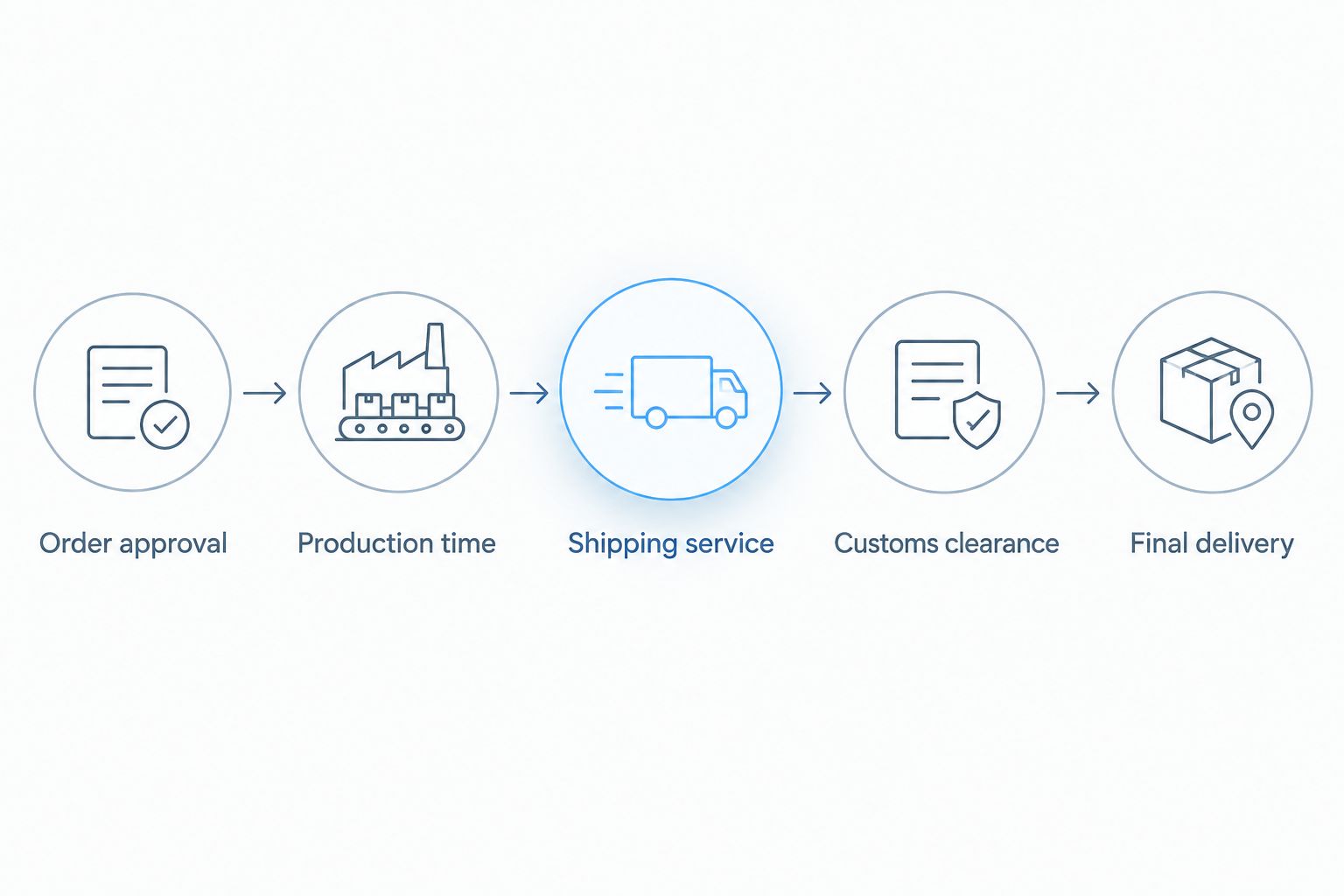
A delivery estimate starts before the parcel reaches the carrier.
These factors also explain why a storewide shipping statement can mislead shoppers. Products made in different places, or sent through different services, do not share a single route. Match the estimate to what is in the cart and where it is going.
How should you estimate delivery for a Shopify customer?
Build the estimate from the order the customer will actually place. You need the chosen product, its production location and the destination before a shipping-service quote is useful. Keep production and delivery language separate on the product page.
- Confirm the product and method. A standard printed item and an item requiring additional personalisation are not interchangeable when you ask a supplier for a production estimate.
- Confirm where it will be made. Use the production location for that product, not a general statement about the supplier.
- Ask when it will be ready to dispatch. This is the production portion of the order-to-delivery window.
- Check the service for the destination. Use the carrier estimate that applies to the buyer’s address and selected shipping option.
- Check what the estimate excludes. Ask whether customs clearance or any required approval sits outside the stated window.
- Present the full window to the buyer. Make clear whether you are showing a dispatch estimate, a transit estimate or an estimated delivery date.
A 2026 delivery message should tell the shopper what the date means. If you only have a dispatch estimate, label it as dispatch. If the final delivery estimate appears at checkout, say so rather than placing a carrier transit window on the product page as if it covered the entire order.
For personalised products, the order details must also reach production correctly. Bespo is best for Shopify merchants who need shoppers to preview personalisation and fulfilment teams to receive production-ready files; it is not a source of carrier delivery estimates. Bespo supports live previews and production-ready output for personalisation such as print, embroidery and engraving. You still need the supplier’s current production window and the carrier’s destination-specific estimate to answer the shipping question.
Can I give every international buyer the same delivery window?
No single delivery window fits every international print-on-demand order in 2026. The production location, destination and shipping service can differ. Use a window tied to the actual route rather than copying an estimate from another product or country.
If you sell to several countries, review what customers see at each destination. The useful question is not whether your store has an international shipping estimate; it is whether that estimate describes the order the shopper is about to place. Keep dispatch and delivery labels distinct wherever they appear.
Does shipping time start when the customer places the order?
No: carrier transit starts after the parcel is handed over, while the customer starts waiting when the order is placed. Include production time when you describe the full wait. If approval is required before production, make that step clear too.
This is the difference between a shipping estimate and an order-to-delivery estimate. Both can be accurate, but they answer different questions. When a customer asks how long an order will take, give them the latter.
What if the order has a deadline?
Do not promise arrival by a deadline from a shipping estimate alone. Confirm production, dispatch and delivery for the specific destination before accepting a date-sensitive order. If any stage remains unconfirmed, say which one.
A recipient’s deadline does not change the supplier’s production process or remove a border crossing. In 2026, the safest customer-facing answer is the confirmed order-specific window, with any approval step identified before the order is placed.
FAQ
How long does international print on demand shipping take in 2026?
There is no fixed international print-on-demand shipping time in 2026. Check the product’s production time, the service for the buyer’s destination and whether customs clearance is covered by the estimate.
Does a print-on-demand shipping estimate include production?
A carrier transit estimate does not describe the production period before dispatch. Check the supplier’s production estimate separately and present the full order-to-delivery window to customers.
Does customs affect international print-on-demand delivery?
Customs clearance can affect an international delivery when the parcel must cross a border. Ask the supplier or carrier what their destination-specific estimate includes.
Is local print-on-demand production faster than international shipping?
Local production avoids a cross-border shipping leg when the chosen product can be made near the buyer. Compare the actual production and delivery estimates before claiming one route arrives sooner.
When should a Shopify store show an estimated delivery date?
Show an estimated delivery date when it reflects the selected product, destination and shipping service. Label a dispatch estimate as dispatch if the full delivery window is not confirmed.
Can Bespo tell customers when an international print order will arrive?
Bespo handles Shopify product personalisation, including live previews and production-ready files; an arrival estimate needs supplier and carrier information. Confirm production and destination-specific delivery terms separately.
Can I promise international delivery for a gift deadline?
Promise a gift deadline only when you have confirmed the full order-specific delivery window. A carrier transit estimate alone leaves out production and any steps before dispatch.
One last thing
Before you publish an international delivery message, read it as a shopper would: does it say when the order ships, or when it arrives? That single distinction prevents a transit estimate from becoming an unsupported delivery promise. Recheck the wording whenever you change a supplier, production location or shipping service.