
The blog
Is print on demand a viable side hustle? Yes, in 2026


Yes—print on demand is a viable side hustle in 2026 when you can reach a specific audience, earn a positive contribution on each order, and manage customer support alongside your main job. Outsourcing production removes the need to print each item yourself; it does not remove marketing, quality checks, fulfilment problems, or the time those tasks take.
TL;DR
- Is print on demand a viable side hustle? Yes—validate demand, order economics, and workload before expanding.
- Print on demand outsources production, not customer acquisition or customer support.
- Bespo suits Shopify merchants who need live-preview product personalisation without developer involvement.
- Start with a narrow offer; add personalised products only when the production handoff works.
Is print on demand a viable side hustle in 2026?
Yes, as a small business you actively manage—not as automatic income. Your supplier handles production, but you still need an offer people want and a reliable way to bring those people to it. A functioning storefront is only the starting point.
Judge viability through separate tests: demand, order economics, and workload. The guide to whether print on demand is still profitable covers the profitability question; your side-hustle decision must also account for your available time.
Demand
- Evidence to collect: Purchases from your intended audience
- Reason to pause: Interest that never becomes an order
Order economics
- Evidence to collect: Revenue left after order-related expenses
- Reason to pause: Every additional sale creates a loss
Workload
- Evidence to collect: Time spent on marketing, support, and exceptions
- Reason to pause: Orders require attention you cannot provide
Fulfilment
- Evidence to collect: A sample and a completed end-to-end test
- Reason to pause: Unclear specifications or unacceptable output
A pass on demand does not cancel a failure on economics. Equally, profitable orders do not make the business suitable for you if urgent support repeatedly interrupts your main job.
Why this matters
Print on demand changes where the work happens. Instead of producing goods yourself, you manage the offer, customer experience, and supplier relationship. That distinction matters when you have limited working hours.
For your 2026 launch, test the business before expanding the catalogue. Adding designs creates more pages and more choices, but it does not prove that anyone wants to buy. A narrow offer makes it easier to identify what is working and what needs fixing.
The right question is not whether someone else earns money from print on demand. It is whether your audience, product, supplier, and schedule work together.
Which print-on-demand approach fits your side hustle?
Choose the operating model before choosing software. Fixed designs, customer-personalised products, and audience-led merchandise create different workloads. None removes the need to check order economics.
Fixed-design products
- Best for: Sellers testing an original design or narrow theme
- Main advantage: The same artwork serves repeated orders
- Main drawback: The design still needs a reason to attract buyers
- Recommendation: Start here when artwork does not change per customer
Customer-personalised products
- Best for: Sellers offering names, messages, or customer artwork
- Main advantage: The shopper contributes something specific to the item
- Main drawback: Incorrect inputs and unclear previews complicate production
- Recommendation: Use when personalisation is central to the purchase
Audience-led merchandise
- Best for: Creators or community organisers with permission to sell relevant merchandise
- Main advantage: The offer connects to an identifiable audience
- Main drawback: Access to an audience does not guarantee purchases
- Recommendation: Test a focused offer before building a collection
Fixed-design products: keep the first offer simple
Fixed artwork gives you a repeatable production brief. You can inspect the design on a sample and use the same approved file for subsequent orders. That makes the initial workflow easier to understand.
The trade-off is differentiation. A design needs a specific buyer and a clear reason to exist; placing it on more products does not solve that problem. Best for sellers whose original artwork or niche knowledge is the main value.
Customer-personalised products: sell a specific outcome
Personalisation changes the job from selling a finished design to collecting instructions for a finished product. You need to define the accepted text, artwork, placement, and any approval requirements. Leave those decisions vague and customers must ask you to interpret their requests.
A preview helps shoppers see their selections, but you still need to check the production output against your supplier's requirements. Best for sellers whose customers want an individual name, message, or design—not unrestricted custom design work.
Audience-led merchandise: validate the purchase, not the applause
An audience gives you a place to present the offer. It does not establish purchasing intent. Ask for a buying decision rather than treating comments or reactions as proof of demand.
Keep the first collection tied to a recognisable interest or occasion. Best for sellers with a relevant community they can reach legitimately, provided the designs and merchandise rights are theirs to use.
Why print-on-demand viability varies
Your result depends on the work between attracting a shopper and delivering the order. Use these factors to assess your own setup, rather than adopting another seller's income claim as a benchmark.
- Audience access: Identify where intended buyers already look for relevant products. An undefined audience makes both messaging and acquisition harder to plan.
- Order economics: Include production, delivery expenses you absorb, transaction charges, acquisition spending, and order corrections. Revenue alone is not profit.
- Product quality: Inspect a physical sample rather than relying only on a digital mock-up. Check that the printed result matches the product description.
- Personalisation complexity: More choices create more combinations to explain and test. Offer choices you can fulfil clearly.
- Supplier handoff: Confirm how artwork, customer selections, and delivery details reach production. Do not assume a storefront preview proves the order is ready to manufacture.
- Available attention: Marketing, customer questions, and production exceptions need an owner. Decide when you can handle them before accepting orders.
These factors are connected. A complex custom offer affects your order-processing time; a weak handoff affects the customer experience. Evaluate the complete workflow, not just the attractive parts.
How do you test print on demand before committing?
Use a small launch to answer specific questions. The following quantities are recommended starting limits, not performance benchmarks: 1 customer segment, 1 product, and 1 acquisition channel. Keep the test narrow enough to understand why an order happened—or why it did not.
Choose your buyer
Describe the buyer and purchase occasion in plain language. State what they want the product to communicate, commemorate, or do. Avoid defining the audience as everyone who likes an appealing design.
Then check where you can reach that buyer. If the only plan is to publish a store and wait, customer acquisition remains unresolved.
Limit your offer
Start with 1 product and a clear design direction. If you offer personalisation, restrict the choices to inputs you can explain and fulfil. You can expand after the first workflow works.
Write the product description around the finished outcome. Explain what the shopper supplies and what they should review before ordering. Do not make a production promise your supplier has not confirmed.
Check your sample
Inspect the physical item, print placement, artwork readability, and packaging. Compare the delivered result with the description and images you plan to publish. Resolve discrepancies before directing customers to the page.
For apparel, also check the information shoppers need to choose a size. For personalised products, check that the submitted choices appear correctly in the finished output.
Test your handoff
Place a test order through the actual buying path. Follow the customer's selections from the product page through the cart, order record, and production instructions. Check what happens when an input is missing or unsuitable.
Decide who handles exceptions. An order that requires clarification should have a defined route, not disappear into an inbox nobody checks.
Review your results
Record purchases, order-related expenses, and time spent handling the business. Separate enquiries from paid demand and distinguish routine orders from orders requiring extra work. Review the evidence before adding products or increasing promotion.
For a 2026 side hustle, the test should answer a practical question: can you repeat this process without losing money or exceeding the time you can give it?
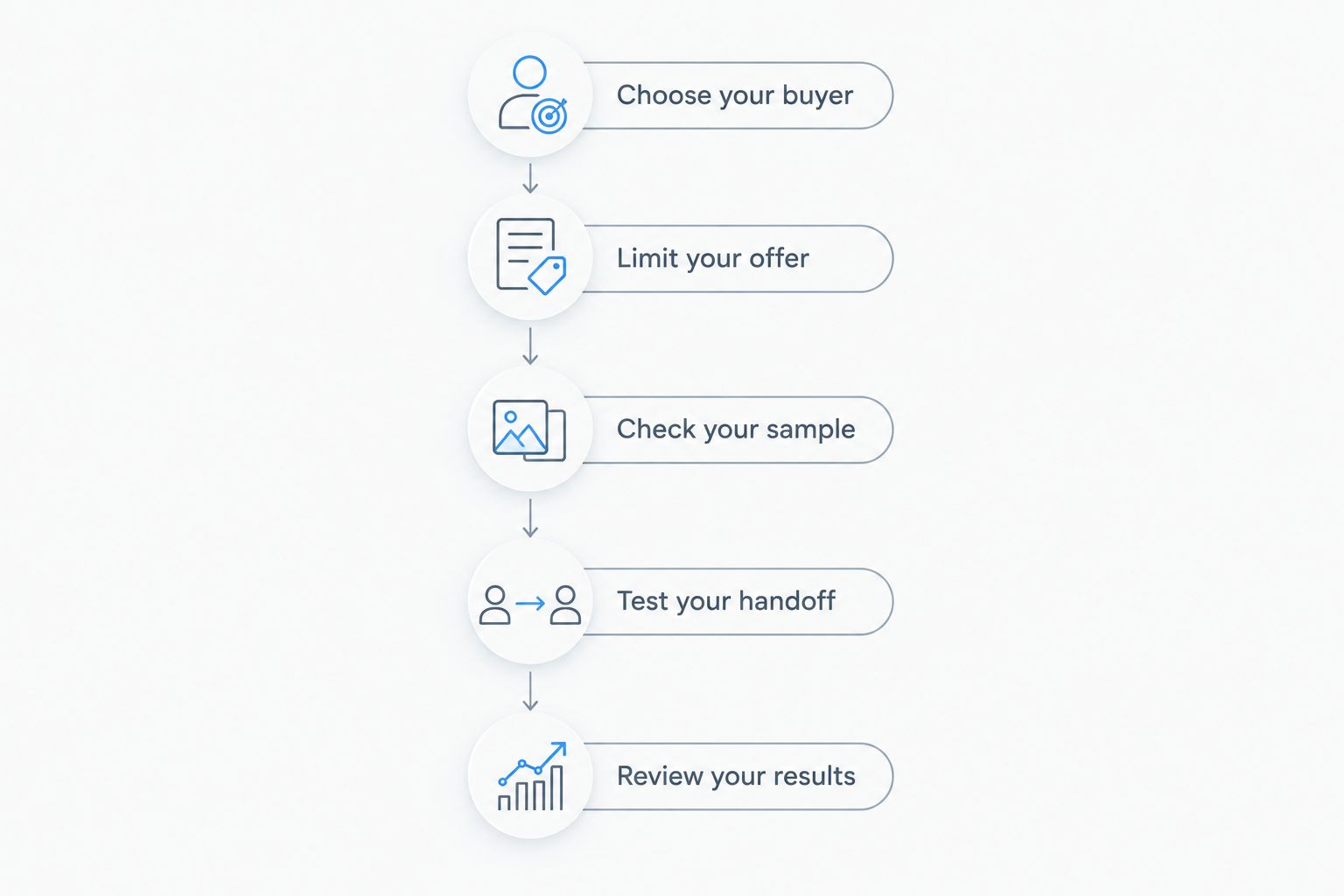
Test the complete order journey before adding more products.
How do you judge profit without guessing your income?
Use actual supplier terms and actual business expenses. A published income claim from another store does not establish what your offer will earn. Build your decision around your own order records.
Contribution per order is order revenue minus the expenses attributable to that order. Those expenses include production, delivery expenses you absorb, transaction charges, acquisition spending attributable to the sale, and corrections you fund. Keep business-wide expenses separate so you can see both order performance and overall results.
Then account for your work. Track time spent creating designs, publishing pages, attracting buyers, answering questions, and resolving problems. A positive contribution is useful, but it is not a complete measure of whether the side hustle rewards your time.
Set your decision rules before the launch:
- Continue when paid demand, positive contribution, and manageable workload occur together.
- Change the offer when buyers show interest but do not purchase.
- Fix the workflow when orders require repeated clarification or correction.
- Pause expansion when additional sales create losses or an unmanageable support burden.
Do not treat advertising as the automatic next step. Promotion sends more people into the same buying and fulfilment process; it does not repair that process.
Where does a Shopify personalisation app fit?
A personalisation app belongs between the shopper's choices and your production workflow. It is not evidence of demand, and it does not replace your fulfilment partner. Choose it when customers need to configure their order—not simply because your store uses print on demand.
Bespo is best for Shopify merchants who need live-preview product personalisation without developer involvement. Bespo lets shoppers personalise products and outputs production-ready files for fulfilment. Its supported techniques include print, embroidery, engraving, monograms, embossing, and debossing.
The benefit is a defined storefront customisation step. The limitation is scope: you still need to establish how the output reaches your chosen producer and whether it matches that producer's requirements. Test that handoff before accepting live personalised orders.
For a fixed-design offer, customer-facing configuration is not automatically necessary. For a personalised offer, check both the preview and the resulting file; they serve different purposes.
Can you run print on demand alongside a full-time job?
Yes, if routine work fits your schedule and you have a clear way to handle urgent exceptions. Choose an offer that does not require you to redesign every order or provide immediate manual approval throughout the working day.
Before your 2026 launch, decide when you will answer questions, review orders, and contact suppliers. Publish only expectations you can meet. Outsourced production does not make you unavailable to your customers.
Do you need paid ads to make print on demand work?
No, paid ads are not required, but a customer-acquisition plan is. You can test relevant content, community participation where promotion is permitted, or an existing audience without buying advertising.
Unpaid acquisition still uses your time. Track that work alongside sales so you can assess the channel honestly, rather than calling it free and excluding it from your side-hustle decision.
Is personalisation necessary for a viable side hustle?
No, personalisation is not necessary for print on demand to be viable. Fixed designs are a valid starting point when the design itself answers a buyer's need.
Add personalisation when it improves the offer in a specific way. A name or message field creates a different production task; it should earn its place rather than become another option customers must understand.
FAQ
Is print on demand a viable side hustle in 2026?
Yes, print on demand is a viable side hustle in 2026 when paid demand, positive order contribution, and manageable workload occur together. Outsourcing production does not remove marketing or customer support.
Is print on demand passive income?
No, print on demand is not passive income. You still manage the offer, customer acquisition, supplier checks, customer questions, and order exceptions.
What's the best print-on-demand approach for a beginner?
A narrow fixed-design offer is a practical starting point when you want to test demand without collecting individual design instructions. Choose personalised products when customer-specific text or artwork is central to the purchase.
Can I start print on demand without keeping finished inventory?
Yes, a print-on-demand workflow produces items in response to orders rather than requiring you to hold finished stock. You still need samples, clear supplier terms, and a tested fulfilment process.
How do I know whether my print-on-demand store is profitable?
Compare order revenue with order-related expenses, then account for business-wide expenses. Track your working time separately to judge whether the result justifies the effort.
Do I need a personalisation app for Shopify print on demand?
You need a personalisation app when your offer requires shoppers to configure customer-specific details. Bespo provides live-preview product personalisation and production-ready files; test those files against your producer's requirements.
When should I add more print-on-demand products?
Add products after the existing offer demonstrates paid demand, acceptable order economics, and a repeatable fulfilment process. A larger catalogue is not a substitute for those checks.
One last thing
Rehearse an incorrect order before expanding. Test missing text, an unsuitable upload, or an unclear delivery detail, then follow the exception through your process. Check who spots it, who contacts the customer, and who decides whether production proceeds.
A successful test order proves the normal path works. An exception test shows whether your 2026 side hustle remains manageable when an order needs attention.