
The blog
Print on Demand vs Dropshipping for New Stores (2026)


Print on demand and dropshipping both let you launch a Shopify store with zero inventory in 2026, but they solve different problems. Print on demand is the better choice when you want control over product quality and margin; dropshipping is the better choice when you want the widest catalog for the least upfront work. Either model runs on most platforms, so picking the best ecommerce platform for small business matters less than the fulfilment model.
TL;DR
- Print on demand is better than dropshipping for a new store built on brand, quality and repeat buyers in 2026.
- Dropshipping wins on catalog size and upfront cost; print on demand wins on margin control and product consistency.
- Both skip inventory, but print on demand ties your name to fewer, better products instead of trend-chasing.
- Bespo adds live product personalisation to print on demand or dropshipped items without a developer, live in under 5 minutes.
Why this matters
Picking a fulfilment model before you've picked a niche is the most common mistake new Shopify sellers make in 2026. Dropshipping earned its reputation for speed because you can list thousands of products in an afternoon. Print on demand earned its reputation for quality because every item ships made-to-order under your own branding.
Neither reputation tells you which one actually grows a store past the first few months. That question also intersects with a separate one worth settling early — is print on demand still profitable once you factor in per-unit costs — and the answer changes how you should read the comparison below. What decides it is what you're optimising for: the fastest possible launch and the widest catalog, or slower, more defensible margin and a product nobody else is selling identical.
Is print on demand better than dropshipping for a new store?
Print on demand is the better choice for a new Shopify store in 2026 when you want to own product quality, protect margin over time, and build something customers remember by name. Dropshipping is the better choice when your priority is testing many products fast with the smallest possible upfront commitment. Most stores that survive past year one land in the print on demand camp, or a hybrid where personalisation replaces a plain dropshipped item with something buyers can't price-compare.
Product ownership
- Print on Demand: You control design, branding and quality on every unit
- Dropshipping: Supplier controls the product; you control the listing
Margin control
- Print on Demand: Per-unit cost is fixed and known before you sell
- Dropshipping: Margin shifts with supplier pricing and shipping surcharges
Catalog breadth
- Print on Demand: Limited to what your printer or supplier can produce
- Dropshipping: Effectively unlimited — list anything a supplier stocks
Shipping speed
- Print on Demand: Made to order, so production adds a step before shipping
- Dropshipping: Ships from supplier stock, often faster once an order lands
Returns
- Print on Demand: Personalised or made-to-order items are usually final sale
- Dropshipping: Standard stock items are easier to restock and resell
Startup effort
- Print on Demand: Needs a design or personalisation step per product
- Dropshipping: Needs a catalog import and pricing pass, less setup per item
Print on demand wins on brand and margin control; dropshipping wins on speed and catalog size — that's the actual trade-off, not a universal answer.
Print on demand: how it works for a new store
An order triggers production, the item is made and shipped, and you never hold stock. The base cost per unit is fixed, so you know your margin before you list the product, unlike a dropshipped item whose landed cost can move with supplier pricing.
The real advantage shows up when you add personalisation. A name, monogram, colour choice or engraved detail turns a print on demand product from a commodity into something a shopper can't find identical anywhere else. If a supplier can't tell you who prints your product, you don't own it — you're renting it for a season. Bespo lets you add that kind of live-preview personalisation to a print on demand product page without a developer, typically live in under 5 minutes.
Best for: sellers who want a defensible product buyers can't find identical and cheaper on a marketplace. Buy this model if brand and repeat purchase matter more than catalog size.
Dropshipping: how it works for a new store
A supplier holds the stock, and your store forwards orders directly to them for fulfilment. Upfront cost is near zero, and catalog breadth is effectively unlimited — you can list a product the same day you find it.
The trade-off is control. You can't guarantee print quality, packaging or shipping time, and if ten other stores use the same supplier catalog, customers can find the identical item at a lower price with one search. That's the ceiling dropshipping runs into by year one: a race to the bottom on price for a product nobody's store actually owns.
Best for: sellers testing demand across many products fast, with minimal capital at risk. Hold this model for validation, then move winners into a model you control more of.
Why the two models perform differently in 2026
- Brand control — print on demand attaches your name to the physical product; dropshipping attaches your name to a listing someone else fulfils.
- Profit margin per unit — fixed and known upfront with print on demand; variable with dropshipping as supplier pricing shifts.
- Product range — dropshipping can list far more SKUs; print on demand caps out at what your printer supports.
- Supplier quality control — print on demand producers work under a relationship you can audit; dropshipping suppliers are often anonymous marketplace vendors.
- Shipping speed — dropshipping frequently ships from existing stock; print on demand always adds a production step first.
- Return handling — made-to-order and personalised items are typically final sale; standard dropshipped stock is easier to restock and resell.
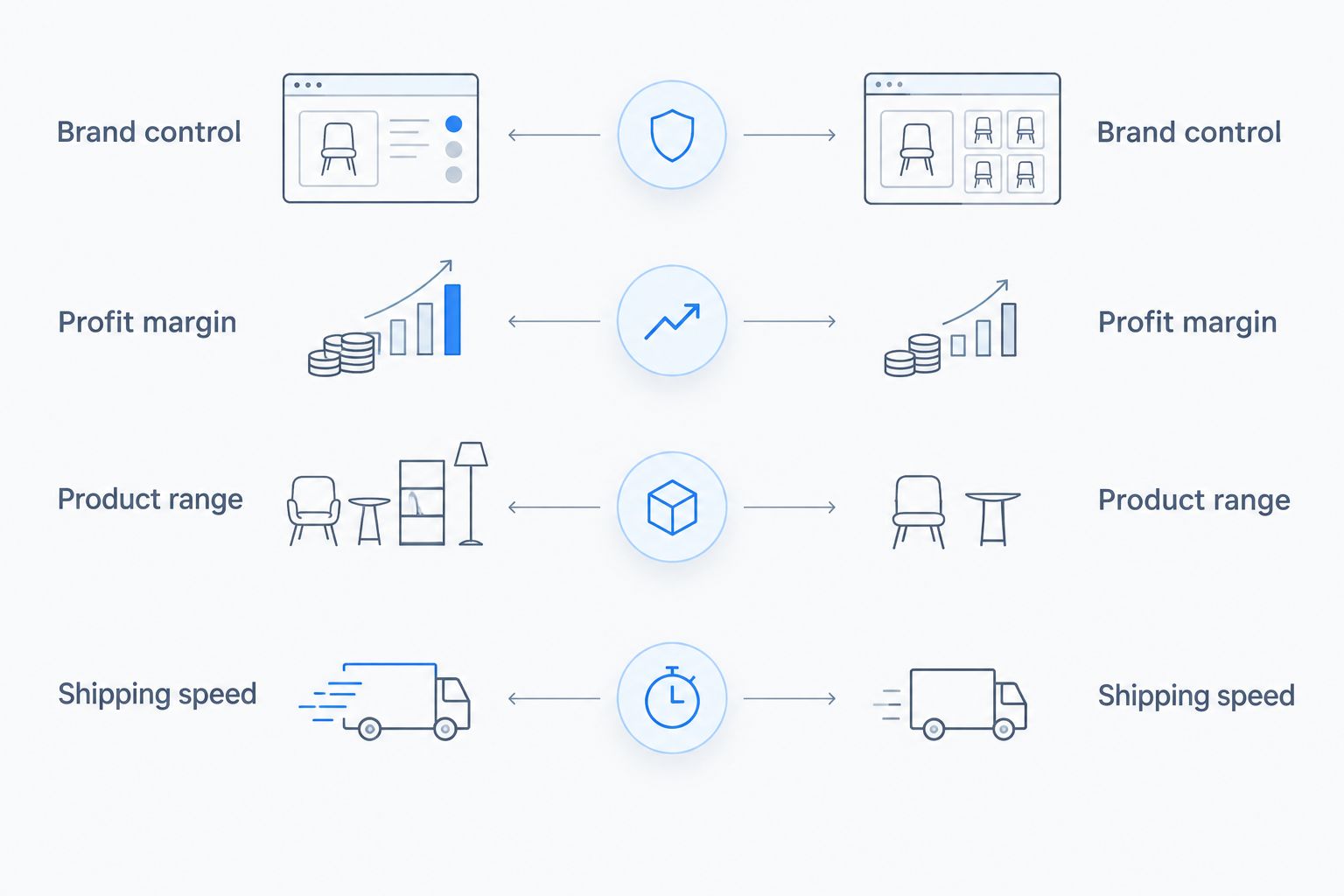
Each model trades brand control and margin for range and speed, not the other way around.
Neither list makes one model universally right for 2026 — it just makes the trade-off visible before you commit a launch budget to one direction.
Start selling personalised products
Add live personalisation to any product without hiring a developer.
Is print on demand more profitable than dropshipping in 2026?
Print on demand is generally more profitable per unit in 2026 because the fixed base cost lets you set a margin you can defend, while dropshipping margin narrows whenever a supplier raises prices or adds shipping fees. Profitability still depends on picking a niche that isn't already saturated with the same product from ten other stores.
Which model is easier to start as a solo founder?
Dropshipping is easier to start because importing a supplier's catalog takes an afternoon, not a design process. Print on demand takes longer to set up upfront but needs less ongoing supplier management once the products and personalisation options are live.
Can you run both models in the same Shopify store?
Yes — plenty of 2026 stores run a dropshipped core catalog alongside a smaller print on demand or personalised line for higher-margin items. The personalised line, built with a tool like Bespo, is usually what stops customers from price-shopping the rest of the store.
FAQ
Is print on demand better than dropshipping for a new store?
Print on demand is better than dropshipping for a new Shopify store in 2026 when brand control and margin matter more than catalog size. Dropshipping still wins for sellers who want to test the widest range of products with the least upfront commitment.
Does print on demand cost more than dropshipping to start?
Print on demand usually costs less to start because there's no bulk stock to buy, but the per-unit cost stays fixed no matter how many you sell. Dropshipping can start even cheaper, though margin narrows fast once suppliers raise prices or add shipping fees.
Which is easier for a solo founder to run in 2026?
Dropshipping is easier to launch because listing a supplier's catalog takes an afternoon, not a design process. Print on demand takes longer to set up but needs less ongoing supplier management once the products are live.
Can you combine print on demand and dropshipping in one Shopify store?
Yes — many 2026 stores run a dropshipped core catalog alongside a smaller print on demand or personalised line for higher-margin items. The personalised line is usually what keeps customers from price-shopping the rest of the store.
Is print on demand still profitable in 2026?
Print on demand is still profitable in 2026 for stores that avoid saturated, trend-chasing niches and build around a product buyers can't find identical elsewhere. Profitability varies significantly by product category and supplier choice.
Does dropshipping still work in 2026?
Dropshipping still works in 2026 for sellers focused on volume and fast product testing rather than brand-building. It works less well as a long-term model once competitors list the same supplier catalog at a lower price.
What personalisation options work with print on demand products?
Name and monogram text, photo uploads, colour and font choices, and engraving or embossing all work with print on demand products when the app supports a live preview before checkout. Bespo covers embroidery, engraving, monograms, embossing, debossing and print across those live-preview product pages.
Do I need a developer to add personalisation to a Shopify store?
No — apps built for this, including Bespo, add a live personalisation block to an existing product page without a developer, typically live in under 5 minutes.
One last thing
The stores that switch from dropshipping to print on demand in 2026 almost always do it for one reason: they got tired of competing on price against ten other stores selling the identical item. Personalisation removes that comparison entirely — a monogrammed tumbler or an engraved keychain with the buyer's own name doesn't have a like-for-like price match anywhere. That's the structural advantage print on demand hands you, and it's the one dropshipping can't replicate without becoming a different model altogether.