
The blog
Is Print on Demand Worth It? Test Before Switching — 2026


Yes—print on demand is worth it for a brand that already dropships when it serves your existing buyers and leaves a positive contribution after fulfilment, acquisition and support. It adds production and artwork checks, not just another supplier. In 2026, treat it as a focused product test rather than a reason to replace a working dropshipping catalogue.
TL;DR
- Is print on demand worth it for a brand that already dropships? Yes, when buyer fit and contribution justify it.
- Keep successful dropshipping products; test printed products that serve the same customers.
- Shopify merchants need to verify artwork, order details and fulfilment before launching personalised print-on-demand products.
- Bespo supports Shopify personalisation with live previews and production-ready files; manufacturing still needs a separate workflow.
Why this matters
Adding print on demand changes what you must check before an order ships. A standard dropshipped item needs the correct product and delivery details; a personalised printed item also needs the correct design, placement and production instructions.
Your advantage is an existing store and customer history. Use that evidence to choose the test instead of building an unrelated merchandise catalogue. For the storefront side, start with the guide to Shopify product customizer apps for dropshipping stores.
Keep the decision narrow: does this product earn its place in your current business? A new fulfilment method is not a customer benefit by itself.
Is print on demand worth it for a brand that already dropships?
Print on demand is worth testing when the design or personalisation gives your existing customer a clear reason to buy. It is not an automatic improvement over dropshipping, and it does not prove demand for a new category.
Compare the approaches by buyer fit and operational work. Choose the simplest approach that delivers the product your customer actually wants.
Standard dropshipping
- Best for: Selling supplier-made products that already meet customer needs
- Main advantage: No artwork preparation for ordinary products
- Main drawback: Your offer relies on the supplier's product rather than your own design
- Decision: Keep products that earn their place
Fixed-design print on demand
- Best for: Selling your own approved artwork to an existing audience
- Main advantage: The same design can be reused across orders
- Main drawback: You must validate the physical print, not just the mockup
- Decision: Test a relevant design
Personalised print on demand
- Best for: Buyers who want names, messages or individual designs
- Main advantage: The buyer contributes to the finished product
- Main drawback: Each order carries customer-specific production details
- Decision: Test only after validating the handoff
The strongest reason to add print on demand in 2026 is a specific offer your current catalogue cannot deliver. That might be original artwork or a customer-selected message. Neither guarantees sales; both give you something concrete to validate.
The weakest reason is access to a large supplier catalogue. Catalogue size does not tell you whether your buyers want the products or whether fulfilled orders leave enough contribution.
Keep standard dropshipping for proven products
Best for: products whose value does not depend on custom artwork. Keep this approach when your current supplier-made item answers the customer's need and your order records support continuing it.
Its benefit is a simpler specification. You are not adding a print file, spelling check or design approval to an ordinary order. Its limitation is equally clear: selecting a supplier's existing item does not create original artwork for your brand.
Do not retire a successful item merely because a printed alternative exists. Compare the finished products, their customer purpose and the work needed to deliver them. Verdict: keep the proven offer unless the new one solves a distinct customer need.
Test fixed-design print on demand for original artwork
Best for: buyers who want your design without configuring it themselves. Fixed-design print on demand lets you approve the artwork before customers place orders, rather than preparing a unique design for every purchase.
That simplifies the artwork workflow. You still need to check the blank product, print placement, colour reproduction and supplier instructions against a physical sample. A digital mockup is not a finished-product inspection.
Use artwork you own or have permission to sell. Keep the first offer close to what your audience already buys, and explain the product without relying on its production method as the selling point. Verdict: test relevant artwork, not generic catalogue expansion.
Test personalised print on demand for individual designs
Best for: buyers who need their own text, message or design on the product. Personalised print on demand adds customer input to the order, so you must preserve that input through checkout and production.
The benefit is an individual finished item. The drawback is more detail to validate: spelling, layout, file suitability and the relationship between the preview and the production output.
Start with constrained choices rather than an unrestricted design brief. Make the accepted inputs clear, and reject production combinations your supplier cannot fulfil. Verdict: launch only when the chosen design reaches production without ambiguity.
Why the value of print on demand varies
There is no universal margin or conversion improvement that makes print on demand worthwhile for every dropshipping store. Your 2026 decision belongs in your own order records, with these factors checked separately:
- Buyer fit. Choose a product that serves the same person and purchase occasion as your existing offer. An unrelated category needs its own demand test.
- Contribution. Include production, shipping, payment processing, acquisition, replacements and order-related support. Revenue alone does not settle the decision.
- Product quality. Inspect a physical sample against the product page. Check the item itself as well as the print.
- Production handoff. Verify that the supplier receives the correct artwork and order details. For personalised items, include every customer-selected input.
- Delivery and service. Confirm the supplier's process, shipment information and remedy for mistakes. Explain the actual customer experience before accepting orders.
Judge the full order, not the supplier's base production charge. A product that needs repeated manual correction belongs in a different operational category from one that arrives ready to produce.
How do you test print on demand without disrupting your store?
Use a controlled test with a written decision rule. Keep existing products live, separate the new orders in your reporting, and validate production before promoting the offer.
1. Choose the offer
Start with 1 product type as a recommended test limit, not an industry benchmark. Pick an item with an understandable role in your existing catalogue, then write the buyer's reason for choosing it.
Be specific. Original artwork, a personal message or a particular use case is clearer than simply announcing that your store now offers print on demand. If you cannot explain the product's purpose, do not expand the range yet.
2. Check contribution
Build an order-level worksheet from your actual supplier terms and store records. Subtract variable fulfilment, payment, acquisition and service costs from net sales revenue; account separately for setup work and recurring overhead.
Track contribution per order, not only total sales. Where a cost varies, record the actual cost of the fulfilled order rather than assuming the same figure applies to every destination or product configuration.
Set your acceptance rule before results arrive. Compare the new offer with your current business on the same basis, so a higher basket total does not hide extra production or support work.
3. Inspect the product
Order a sample with the artwork or personalisation you intend to sell. Inspect material, construction, print placement and legibility, then compare the sample with your product-page description.
For personalised items, test the limits you allow customers to use. Check long text and permitted characters rather than approving only the easiest example. Reduce the available choices if the output does not meet your standard.
4. Validate the handoff
Test 2 order paths as a minimum practical checklist: a printed item purchased alone, and a printed item purchased with an existing dropshipped item. These are recommended checks, not a claim about how customers shop.
For each path, trace product details, artwork, delivery information and shipment updates. Confirm what happens when different suppliers handle the same basket, including how you will explain separate parcels if they occur.
5. Run the test
Publish the product only after the sample and order flow pass your checks. Use existing customer evidence to choose how to introduce it, and keep the message focused on what the buyer receives.
For your 2026 test, record completed orders, contribution, cancellations, replacements and support work. Review those records together. An order count alone does not show whether the new offer is useful to the business.
6. Make the decision
Choose between 3 decisions: keep, revise or stop. Keep the offer when it meets your written contribution and operational requirements; revise a specific fixable problem; stop an offer that fails those requirements.
Do not add more designs to avoid confronting a poor result. Fix the product, artwork or handoff first, then repeat the relevant checks before expanding.
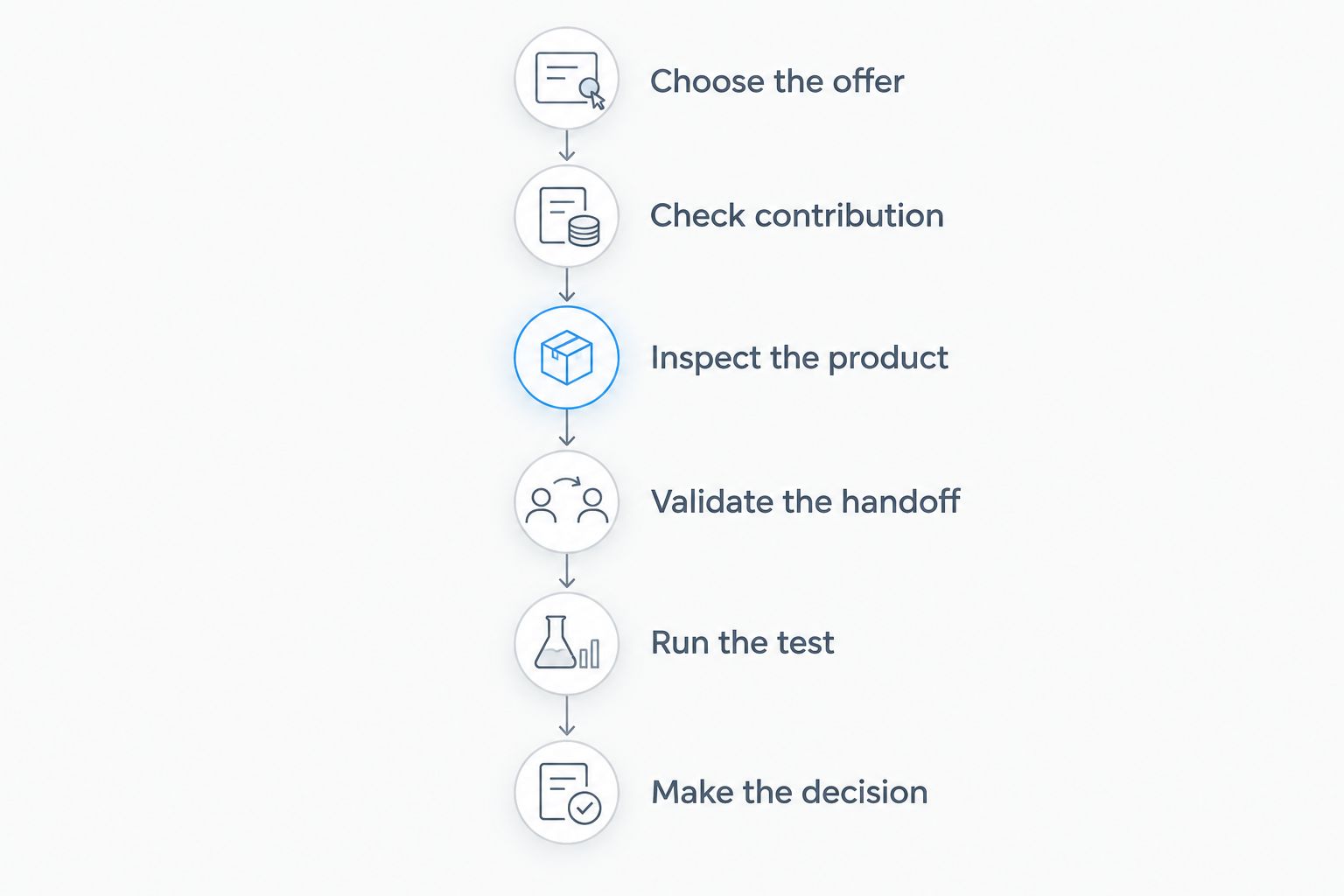
Validate the product and production handoff before running the sales test.
Where does a Shopify personalisation app fit?
A personalisation app handles the customer's design choices; manufacturing and dispatch need their own confirmed workflow. Keep those responsibilities separate when selecting software.
Bespo is best for Shopify merchants who need no-developer product personalisation, live previews and production-ready files. Bespo supports real-time storefront personalisation, including print, embroidery, engraving, monograms, embossing and debossing.
The practical benefit of Bespo for a personalised print offer is the live-preview customiser and production-ready output. The boundary is fulfilment: validate the files against your chosen manufacturer's requirements, and confirm how orders reach production. A storefront preview does not establish a supplier's print quality or delivery process.
Choose Bespo for the personalisation workflow, not as evidence that a product will sell. A fixed design that needs no customer input presents a different software requirement from an item the shopper configures.
Should you replace dropshipping with print on demand?
Do not replace a working dropshipping catalogue solely to adopt print on demand. Keep the existing offer while you test whether a printed product meets your customer and contribution requirements.
Replacement is a separate decision. Make it from fulfilled-order results and operational evidence, not from a supplier mockup or an untested assumption about brand appeal.
Is print on demand still useful without customer personalisation?
Yes—fixed-design print on demand is useful when buyers want your approved artwork. Customer input is not required for production after an order arrives.
Personalisation adds a different benefit and a different workload. Add it when the customer's choices matter to the finished item, not simply because the feature is available.
Does a higher order value prove the test worked?
No—a higher order value does not prove that print on demand improved profit. Compare contribution after fulfilment, acquisition and service, then assess the additional workload.
Keep average order value in your reporting, but do not use it alone as your 2026 acceptance rule. A larger sale and a better business result are different measurements.
FAQ
Is print on demand worth adding to an existing dropshipping store?
Yes, when the printed product serves your existing buyers and meets your contribution requirements. Test the physical product and fulfilment workflow before expanding the catalogue.
Is print on demand better than standard dropshipping?
Neither approach is automatically better. Standard dropshipping suits supplier-made products, while print on demand suits offers whose value includes original artwork or personalisation.
Can I sell dropshipped and print-on-demand products in the same store?
Yes, you can offer both in the same store. Validate mixed-product orders and explain separate shipments whenever your fulfilment arrangement creates them.
Do I need a personalisation app for fixed-design print on demand?
Customer personalisation is not necessary for a fixed design. Use a personalisation workflow when shoppers need to choose text, images or other details that change the finished product.
What should I check before selling personalised printed products?
Check the physical sample, permitted customer inputs and production handoff. Confirm that the final artwork and order instructions match what the customer selected.
Can print on demand guarantee a higher average order value?
No, print on demand does not guarantee a higher average order value. Measure your own completed orders and assess contribution alongside basket size.
When should I stop a print-on-demand test?
Stop when the offer fails your written contribution or operational requirements and you have no specific corrective action. Do not expand the range to disguise an unresolved problem.
One last thing
Test the ordinary mixed basket before polishing another mockup. A printed item ordered with an existing dropshipped product exposes the handoffs your product page does not show: supplier routing, shipment communication and support responsibility.
That is the useful final check for a 2026 launch. Prove that you can explain and deliver the whole order—not just make the new item look convincing.