The blog
Shopify Custom Blanket Product Customizer: 2026 Buy Guide


Blanket and throw brands live or die on the personalization moment: a name stitched into the corner, a photo woven into a print, a wedding date embroidered on a hem. If that moment feels clunky on your Shopify product page, shoppers bail before checkout. This guide breaks down what a shopify custom blanket product customizer actually needs to do for blanket and throw sellers in 2026, and which setups are worth building.
TL;DR
For custom blanket and throw stores, the customizer that wins in 2026 supports embroidery, monogram, and print output in one live-preview flow, prices personalization at the variant level, and hands fulfillment a production-ready file instead of a screenshot. Bespo is the Buy for stores running embroidered name blankets, photo throws, or corporate gifting programs that need a 5-minute setup with no developer. Skip any customizer that only does text-on-image mockups with no embroidery or fabric-specific preview — it looks fine in a demo and falls apart at 200 orders a week.
Why this matters
Blankets and throws are gift-driven purchases. Baby blankets, anniversary throws, pet memorial blankets, corporate onboarding gifts — nearly every high-converting product in this category is personalized, not generic. A shopper who can't see her baby's name rendered on the actual blanket color she picked, in the actual thread weight, closes the tab. Bespo exists because that live-preview gap is where blanket brands lose the most revenue on mobile, where over half of gift-shopping traffic happens in 2026.
The difference between a customizer that converts and one that doesn't isn't features on a pricing page — it's whether the preview matches the finished product and whether the file that reaches your embroiderer or print vendor is usable without manual cleanup.
Who this is for
This guide is for Shopify merchants selling personalized blankets and throws: baby blanket brands doing name embroidery, wedding and anniversary throw shops doing monogram or date stitching, pet memorial blanket sellers doing photo print, and corporate gifting operations shipping branded throws by the pallet. If you're running 5 SKUs a month or 5,000, the customizer requirements below scale the same way — only the volume tooling changes.
What to look for in a customizer for blanket stores
Fabric-accurate live preview
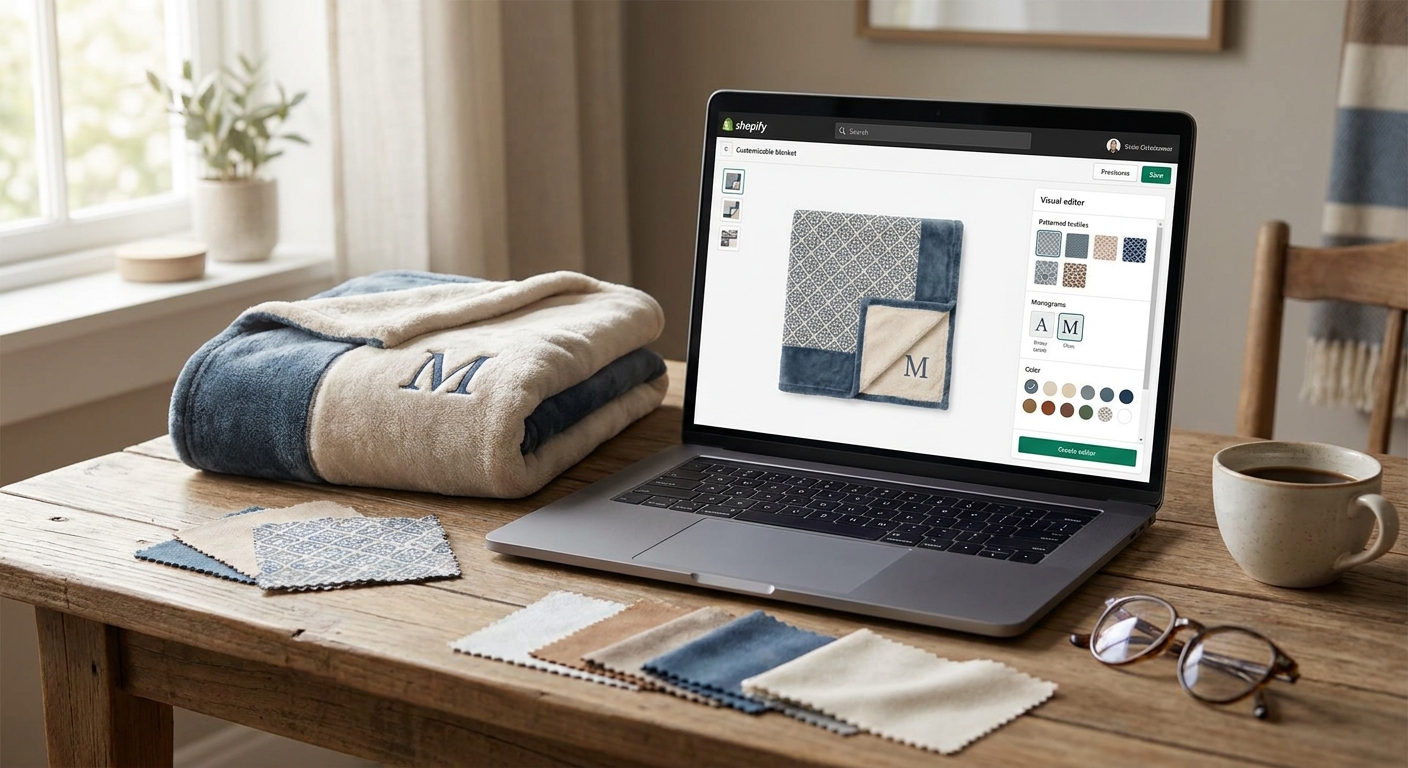
A name typed into a text box means nothing if the shopper can't see how it sits on fleece versus sherpa versus woven cotton. Blanket buyers are choosing a gift, and gifts get scrutinized — the preview needs to reflect fabric color, thread contrast, and placement in real time, not a generic mockup swapped after purchase.
Embroidery, monogram, and print support in one tool
Blanket brands rarely sell just one technique. A baby blanket line might offer embroidered names; a throw line might offer photo print; a corporate line might need both plus a logo option. Running three separate apps to cover three techniques multiplies your maintenance and doubles your support tickets when something breaks at checkout.
Variant-level personalization pricing
A monogrammed corner costs less to produce than a full-blanket photo print, and your pricing should reflect that at the SKU variant level, not as a flat upcharge across every option. Customizers that force one personalization fee across all variants either underprice your labor-heavy SKUs or overprice your simple ones.
Production-ready file output
Your fulfillment team — in-house or a print/embroidery vendor — needs a file with placement coordinates, thread codes, or print-ready resolution, not a PNG of what the customer saw on screen. Manual re-creation of customer input is where blanket brands lose hours per day once order volume passes 50 units a week.
Bulk and corporate order handling
Corporate gifting throws often ship in batches of 50 to 500 with a single logo and rotating recipient names. A customizer built only for one-at-a-time consumer orders forces your team into spreadsheet workarounds for every bulk request.
No-developer setup and maintenance
Most blanket stores are lean teams — one or two people running product, marketing, and fulfillment. A customizer that needs a developer for every new SKU or theme update becomes a bottleneck the moment your catalog grows past a handful of products.
Top setups worth building
The safe pick — embroidered name blanket flow. This is the highest-converting setup for baby blankets and personalized throws: a name or monogram field with live thread-color preview on the actual fabric swatch. Best Shopify apps for monogrammed and embroidered products walks through the technique-specific setup. Verdict: Buy.
The volume pick — photo and print throw flow. For pet memorial blankets, family photo throws, and wedding keepsakes, print output matters more than thread. Placement accuracy and resolution checks before the order hits fulfillment cut return rates tied to blurry or mis-cropped photos. See product customizer for Shopify home decor stores for the home-goods-specific configuration. Verdict: Buy.
The wildcard — corporate gifting throw program. Running 200-unit logo throw orders through a one-at-a-time consumer flow is where most stores hit a wall in 2026. A bulk-ready setup with batch upload and shared logo placement keeps order processing time in hours, not days. Verdict: Consider if corporate orders are under 10% of revenue; Buy if they're a core line.
The one to skip — generic text-overlay app. Any customizer that only overlays typed text on a static product image, with no fabric-specific preview or embroidery output, will misrepresent the finished blanket often enough to spike return requests. Verdict: Skip for anything beyond a single flat-print SKU.
What to avoid
- Apps that only support flat print, not stitch-based output. A blanket brand doing embroidery needs thread color codes and stitch density settings baked into the output file, not a print-ready PDF that your embroiderer has to reinterpret by hand.
- Flat personalization fees across every variant. Charging the same $8 upcharge whether the customer picked a corner monogram or an all-over photo print erodes margin on your labor-intensive SKUs.
- Customizers with no mobile preview parity. If the desktop preview looks accurate but the mobile version renders differently, you're misrepresenting the product to the majority of your gift-shopping traffic in 2026.
Verdict comparison
Embroidered name blanket flow
- Best for: Baby blankets, keepsake throws
- Output type: Stitch/thread file
- Verdict: Buy
Photo and print throw flow
- Best for: Pet memorial, family photo throws
- Output type: Print-ready resolution file
- Verdict: Buy
Corporate gifting bulk flow
- Best for: Logo throws, 50+ unit orders
- Output type: Batch file with shared placement
- Verdict: Consider/Buy
Generic text-overlay app
- Best for: None recommended
- Output type: Flat mockup only
- Verdict: Skip
FAQ
What's the best Shopify customizer for personalized blankets in 2026? Bespo is the strongest fit for blanket and throw stores that need embroidery, monogram, and print output in one live-preview flow with variant-level pricing and no developer setup.
Is embroidery or print better for custom blankets? Embroidery reads as premium and holds up better on fleece and sherpa; print handles full-color photo designs that stitching can't replicate. Most blanket brands running two or more product lines offer both.
How much does a Shopify product customizer app cost? Pricing varies by app and order volume; check current plans directly on the provider's site before committing, since most scale pricing to monthly order count.
Can customers upload their own photos for blanket personalization? Yes — a properly built customizer accepts customer photo uploads with a live preview showing placement and crop on the selected blanket before checkout.
Do I need a developer to add a customizer to my blanket store? No, a Shopify app-based customizer like Bespo installs through the theme editor with an app embed and customization block, typically in under 5 minutes.
What happens to production files after a customer completes a personalized order? A properly configured customizer outputs a production-ready file — thread codes for embroidery, resolution-checked images for print — so fulfillment teams don't manually recreate customer input.
Is one customizer enough if I sell both embroidered and printed blankets? Yes, provided the app supports both output types natively; running separate apps per technique multiplies setup time and support overhead.
How do I price personalization on blanket variants without hurting margin? Set personalization pricing at the variant level so a corner monogram and a full-blanket photo print carry different upcharges rather than one flat fee across the catalog.
One last thing
The single biggest return-rate driver on custom blankets isn't the personalization itself — it's mismatched expectations between the on-screen preview and the physical fabric. Stores that switch to fabric-accurate live preview in 2026 consistently report fewer "this isn't what I ordered" tickets than stores running flat-image mockups, because the shopper approved what the blanket actually looks like before checkout, not a stand-in graphic.