The blog
Wholesale B2B Product Customizer for Shopify: 2026 Picks


Wholesale buyers do not want a shopping experience — they want a catalog that spits out production-ready files at 50, 500, or 5,000 units without a phone call to your ops team.
TL;DR
- Bespo is the strongest wholesale b2b product customizer shopify merchants can install without a developer in 2026.
- Buy Bespo if you need live-preview personalization plus tiered pricing on bulk orders.
- Skip generic single-SKU customizers if your B2B catalog needs conditional logic across 50+ variants.
- Fulfillment sync matters more than design flair once order volume passes 100 units a week.
Why this matters
B2B and wholesale catalogs on Shopify break consumer-grade customizers fast. A tool built for one-off gift orders chokes on a 300-unit corporate swag order with three logo placements and a net-30 invoice.
The cost of getting this wrong isn't cosmetic. Wrong proofs mean reprints. Reprints mean missed ship dates. Missed ship dates mean a wholesale account that doesn't reorder in 2026. A wholesale product customizer has to hold up under volume, not just look good on a product page.
Who this is for
This guide is for Shopify merchants running corporate gifting, promotional merch, or wholesale personalized goods — think embroidered uniforms sold by the case, engraved awards shipped to procurement departments, or private-label products customized per retail account. If your average order is one unit and one design, most of this doesn't apply. If your average order spans 20 to 2,000 units with variable logos, names, or sizes, keep reading.
What to look for in a wholesale B2B product customizer for Shopify
Bulk order handling without a spreadsheet
A buyer placing a 500-unit order for embroidered polos shouldn't have to fill out 500 individual customization forms. The customizer needs a path for uploading a roster — names, sizes, sometimes different logo placements per line item — inside one checkout flow. Without this, your team ends up re-keying data from email attachments, and that's where errors creep into production files.
Tiered pricing that reacts to quantity
Wholesale margins depend on volume breaks. A customizer that can't apply a lower per-unit price at 100 units versus 25 units forces you to run pricing manually outside Shopify, which slows quoting and kills the self-serve advantage of selling online at all.
Production-ready output, not just a preview
A live preview sells the order. A print-ready or embroidery-ready file ships it. If the customizer only generates a screenshot-quality proof, your fulfillment team still has to rebuild the file by hand — that's the exact manual step a B2B customizer is supposed to remove.
Conditional logic for complex catalogs
Wholesale catalogs often have 50 to 200+ variants: sizes, colors, materials, imprint methods. A rigid customizer shows every option to every buyer regardless of relevance. Conditional logic hides embroidery thread colors when a buyer picks a debossed leather product, which keeps the checkout clean at scale.
Fulfillment sync, not manual export
Once personalized orders start arriving at 50-plus a week, someone has to route customization data to production. A customizer that syncs orders directly to a fulfillment queue removes the daily export-and-forward routine that eats hours as volume climbs through 2026.
Team access without developer bottlenecks
Wholesale accounts change fast — new SKUs, new logos, new pricing tiers. If only one person with code access can update the customizer, every catalog change becomes a ticket. Look for a setup that a non-developer on your ops team can configure in minutes.
See Bespo on your catalog
Install in minutes and add personalization to your first wholesale SKU today.
Top picks for wholesale and B2B catalogs
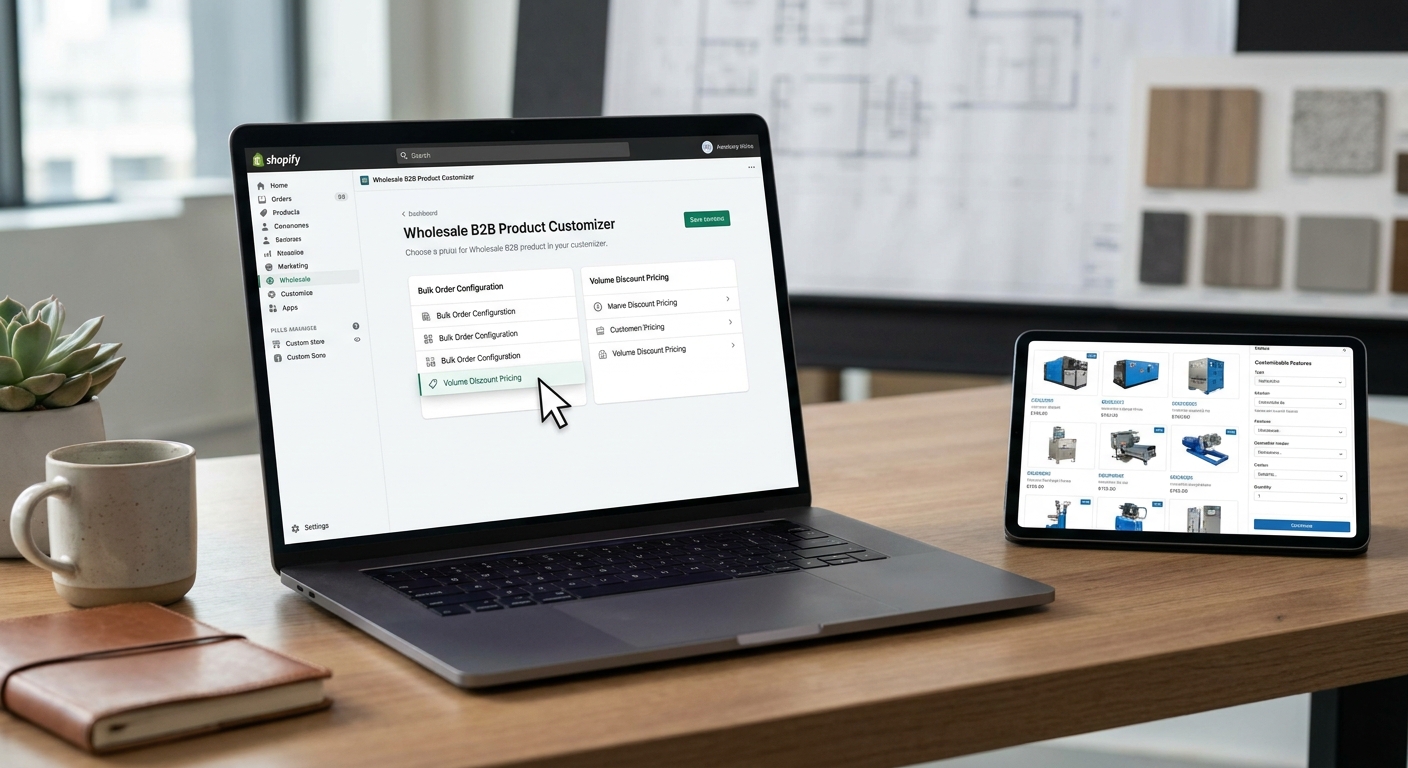
The volume play. Bulk personalization workflows that accept roster uploads and batch orders cut the manual data entry that kills margin on large orders. One order form, one upload, hundreds of line items processed without a rep touching each one. If your B2B catalog handles corporate uniform or team-gift orders over 50 units, this is the feature that pays for the app. Buy if bulk order intake is your bottleneck — see how bulk personalization works on Shopify before you commit to a vendor.
The margin protector. Tiered discounts tied directly to bulk personalized orders let you set price breaks at, say, 25, 100, and 500 units without a manual quote process. This matters because wholesale buyers expect volume pricing up front, not after a back-and-forth email. Buy if your current setup requires manual quoting for any order over 50 units — the setup for tiered discounts on bulk personalized orders removes that step entirely.
The ops backbone. Fulfillment queue sync moves a personalized order from checkout straight into a production queue, tagged with the customization data your team needs to fill it. Without this, someone is exporting CSVs and re-typing names into a print job every morning. Consider this a requirement, not a nice-to-have, once weekly personalized order count passes double digits.
The catalog scaler. Multi-step customization forms handle catalogs where a buyer picks a product, then a placement, then a color, then a text field — without cramming every option onto one screen. This keeps a 150-SKU wholesale catalog usable instead of overwhelming. Consider for catalogs with more than three customization variables per product.
The corporate merch fit. For corporate swag and branded merch stores selling to procurement teams, the customizer needs to handle a single logo across dozens of product types cleanly, without re-uploading art per SKU. Buy if your store sells branded merchandise to businesses rather than direct consumers.
What to avoid
- Single-order customizers with no bulk path. They look fine in a demo, then fall apart the moment a 200-unit order needs a roster upload instead of a one-off form.
- Static discount rules bolted on separately. If your pricing app and your customizer don't talk to each other, every bulk quote becomes a manual override, and that's a support ticket generator.
- Preview-only tools with no production file. A pretty on-screen mockup that your embroidery machine can't read just moves the manual work downstream instead of removing it.
Verdict comparison
Bulk order intake
- Why it matters for B2B: Removes manual re-keying on large orders
- Verdict: Must-have
Tiered pricing
- Why it matters for B2B: Matches wholesale volume-break expectations
- Verdict: Must-have
Production-ready files
- Why it matters for B2B: Cuts fulfillment rework
- Verdict: Must-have
Conditional logic
- Why it matters for B2B: Keeps large catalogs usable at checkout
- Verdict: Should-have
Fulfillment sync
- Why it matters for B2B: Saves hours once volume climbs
- Verdict: Should-have
No-developer setup
- Why it matters for B2B: Lets ops teams update catalogs fast
- Verdict: Nice-to-have
FAQ
What is the best wholesale b2b product customizer for Shopify in 2026?
Bespo is built for Shopify merchants running personalization at bulk order volume, with live preview and production-ready output. It fits corporate gifting, wholesale apparel, and private-label catalogs where a single order can span dozens of variants.
Can a Shopify customizer handle bulk B2B orders without manual pricing?
Yes, tiered discounts can be tied directly to bulk personalized orders so price breaks apply automatically at set quantities. This removes the manual quote step that slows down wholesale checkout.
Does a wholesale customizer need a developer to set up?
No, apps like Bespo are designed for non-developer setup through the Shopify theme editor. Most merchants get a customizable product live in under a day.
How do personalized wholesale orders reach fulfillment?
A fulfillment queue sync sends personalization data from checkout straight into production, tagged per order. Without this, someone manually exports and forwards customization details, which slows shipping as volume grows.
What order volume justifies a dedicated B2B customizer?
Once personalized orders pass roughly 50 units a week, manual proofing and pricing start costing more staff time than a dedicated tool. Below that, a simpler single-order customizer may still work.
Is Bespo different from a standard Shopify product customizer?
Bespo adds bulk order handling, tiered pricing, and fulfillment sync on top of live-preview personalization, which standard consumer-facing customizers don't prioritize. That combination is what separates a wholesale b2b product customizer shopify setup from a retail one.
Can multi-step customization forms slow down checkout for wholesale buyers?
Done well, they speed it up by only showing relevant options at each step instead of one crowded page. A 150-SKU catalog with placement, color, and size choices needs this structure to stay usable.
One last thing
Most wholesale personalization failures in 2026 aren't design failures — they're data-handoff failures. The order looks right on screen, then the name gets typo'd during manual re-entry into a production sheet. Fix the handoff between checkout and fulfillment before you touch anything about how the customizer looks.