
The blog
Can AI Generate Personalized Product Designs in 2026?


Yes, AI can generate personalized product designs automatically in 2026, turning a name, photo, or text prompt into finished artwork in seconds. The catch: most AI tools stop at a good-looking image, not a production-ready file a factory can engrave, embroider, or print without extra cleanup.
TL;DR
- AI can generate personalized product designs automatically in 2026, but only some tools output production-ready files.
- Prompt-to-image generative AI suits photo gifts and wall art; it rarely survives contact with an embroidery or engraving machine.
- Live-preview customizers like Bespo pair AI-assisted previews with locked, print-ready output — the safer bet for volume sellers.
- Preset AI design libraries cut manual review to near zero for solo merchants who can't check every file by hand.
Why this matters
Every Shopify merchant selling monograms, engraved jewelry, or printed apparel eventually asks the same question: can AI do the design work so nobody has to? The answer changes what tooling you buy. A store that treats "AI-generated design" as a marketing checkbox ends up manually fixing files that don't meet embroidery digitizing limits or engraving depth requirements.
A store that picks the right layer of AI — generation, personalization, or curation — cuts production errors instead of creating new ones. That distinction matters more in 2026 than it did two years ago, because generative AI got good enough to fool a merchant into thinking a pretty preview is the same thing as a usable production file. It isn't.
Can AI generate personalized product designs automatically?
Three distinct approaches answer to "AI-generated personalization" in 2026, and they are not interchangeable. The table below breaks down what each one actually produces, whether the output is production-ready, and who it fits.
Generative AI (prompt-to-image)
- What it generates: Original artwork from a text or photo prompt
- Production-ready output?: Rarely — usually needs manual vectorization or cleanup
- Best for: Photo gifts, wall art, one-off pieces
AI-assisted live-preview customizer
- What it generates: Customer's name, monogram, or photo rendered inside a locked template
- Production-ready output?: Yes — outputs a print- or engrave-ready file automatically
- Best for: Embroidery, engraving, and monogramming at volume
Preset AI design library
- What it generates: A pre-approved design a customer picks and lightly personalizes
- Production-ready output?: Yes — files are validated before they go live
- Best for: Solo merchants who can't review every order manually
Stores that lean on AI-generated design previews inside a customizer skip the vectorization step entirely, because the preview and the production file are generated from the same locked template — not a fresh AI render every time.
Generative AI (prompt-to-image) tools: what they're actually good for
Prompt-to-image generators create genuinely original art from a text description or a reference photo. That's useful for one-off wall art, pet portraits, or novelty gifts where the design itself is the product.
It's a weak fit for anything with a hard production constraint. Embroidery has stitch density limits, engraving has minimum line widths, and print has color gamut restrictions a generative model doesn't know exist. Verdict: Wait on pure generative AI for anything you engrave, emboss, or embroider — use it for flat print and photo products only, and plan to clean up the output before it goes to production.
AI-assisted live-preview customizers: the safer automatic option
A live-preview customizer doesn't generate new art — it takes a locked, pre-built template and automatically drops the customer's name, initials, or photo into it, updating the preview in real time. Bespo's product personalization customizer works this way for embroidery, engraving, monograms, embossing, debossing, and print: the shopper sees exactly what gets produced, and the same data that renders the preview becomes the production file.
That closes the gap generative AI leaves open. Merchants who let customers upload their own images still get an automatic design output, but it's bounded by the template rather than invented from scratch. Unlike open generative AI, Bespo's live-preview customizer never produces a file that hasn't already been checked against the technique's limits. Verdict: Buy this approach for any personalized product line where a wrong file means a returned or scrapped order.
Preset AI design libraries: automatic without the risk
Some stores skip open-ended personalization altogether and offer a curated set of AI- or designer-made patterns the customer picks from, then lightly personalizes with text or color. This is the lowest-risk automatic option because every design in the library has already been validated against production limits before a single order comes in.
It's a smaller creative range than generative AI, but for a solo merchant running personalization without a design team, that trade-off is the point. Verdict: Buy for merchants who want personalization live in days, not weeks, without a manual proofing queue.
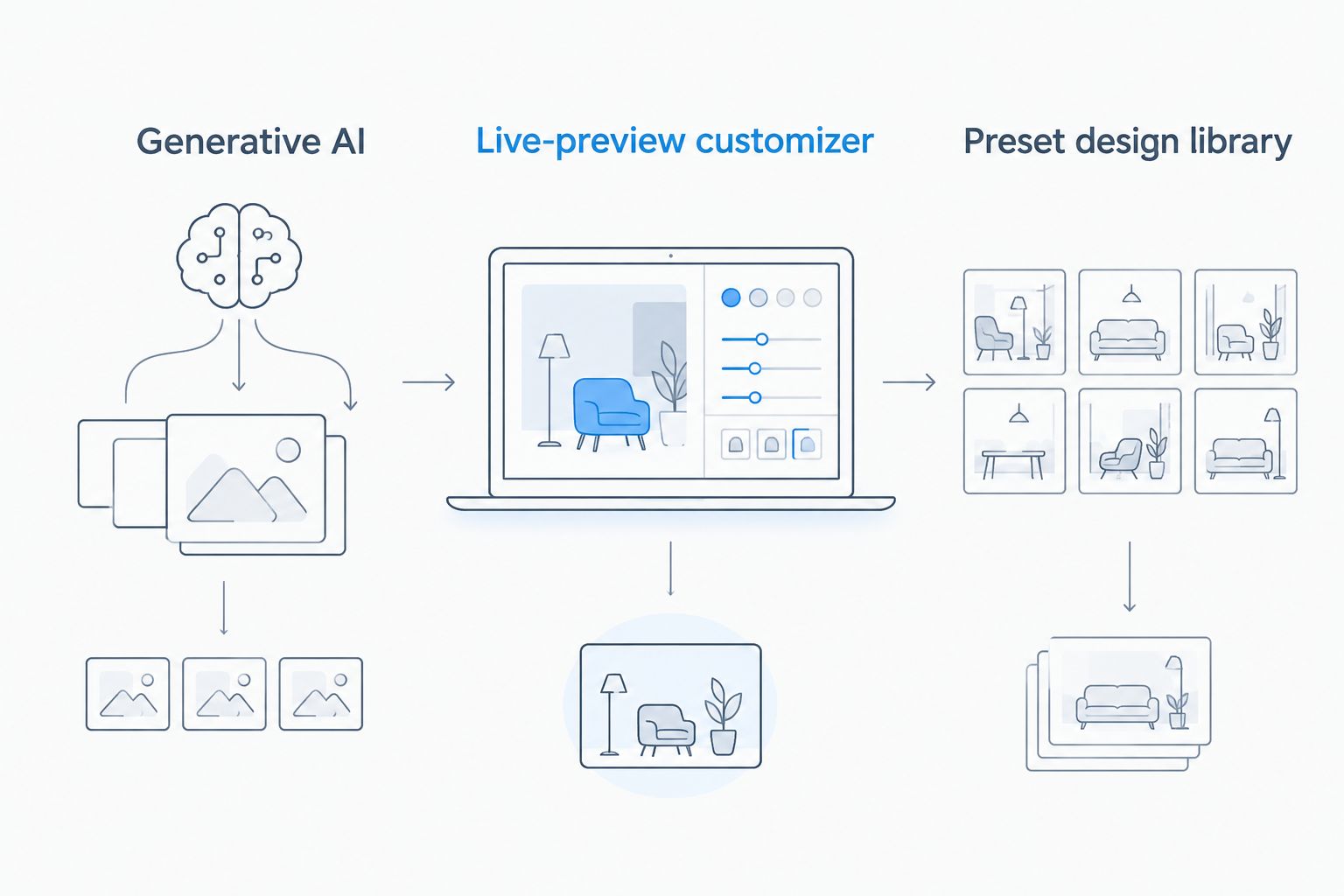
Live-preview customizers are the only approach that outputs a production-ready file automatically.
Why AI design generation results vary
- Input quality — a blurry photo or vague prompt produces a design that needs more manual cleanup, no matter which tool generates it.
- Personalization technique — embroidery, engraving, and print each have different file requirements; a design AI treats as "done" may not be machine-ready.
- Product substrate — wood, metal, and fabric each limit line width, depth, and detail differently than a screen render shows.
- Brand consistency controls — generative AI with no style lock produces wildly different results order to order; template-based tools don't.
- Human proof step — stores that skip a review step on generative output see more production errors, not fewer.
- Catalog size — a library of 20 presets is easy to validate; an open prompt field is not.
See AI design previews in action
See how Bespo's live-preview customizer handles engraving and embroidery automatically.
Can AI design jewelry engravings automatically?
AI can automatically place a name or date into a jewelry engraving template and render a live preview, but it doesn't design the engraving pattern itself — the artwork is pre-built and the AI personalizes it. Stores selling engraved jewelry get the automation benefit without the risk of an AI-generated pattern a laser can't actually cut.
Is AI-generated personalization better than letting customers upload their own photo?
Neither replaces the other — generative AI creates something new, while photo upload personalizes with something the customer already owns, like a pet photo or family portrait. Most gift categories, from mugs to blankets, do better with photo upload personalization because customers want their own image, not an AI interpretation of it.
Do Shopify merchants need a developer to add AI design previews?
No — customizer apps that offer AI-assisted design previews are built to install through the Shopify app store without custom code, typically live the same day. That's different from building a generative AI pipeline from scratch, which does require development work.
FAQ
Can AI generate personalized product designs automatically in 2026?
Yes, AI can automatically generate or personalize product designs in 2026, but the method matters — generative AI creates new art that often needs cleanup, while a live-preview customizer personalizes a locked template into a production-ready file with no extra step.
What's the best AI tool for personalized product design on Shopify?
A live-preview customizer like Bespo is the better fit for embroidery, engraving, and print products because it outputs a production-ready file automatically, not just a preview image.
Can AI replace a human designer for custom products?
AI can replace repetitive personalization tasks like placing a name or monogram, but it hasn't replaced human designers for original pattern or template creation as of 2026 — most stores still start with a human-built template.
Does AI-generated art work for embroidery or engraving?
Rarely without cleanup — embroidery has stitch density limits and engraving has minimum line widths that generative AI models don't account for, so raw AI output usually needs manual vectorization before production.
How fast can a Shopify store add AI-assisted personalization?
Customizer apps built for this typically install and go live within the same day since they don't require custom development, unlike a generative AI pipeline built from scratch.
Is generative AI cheaper than a personalization app?
Cost varies by tool and current pricing, but the bigger difference is time: generative AI output often needs manual cleanup before it's production-ready, while a template-based customizer doesn't.
Can AI generate 3D product previews for personalized items?
Some customizer apps generate a 3D preview automatically from the same data used for 2D personalization, though not every platform supports it — check the specific app's feature list.
One last thing
The most overlooked AI design failure in 2026 isn't a bad image — it's a design that looks flawless on a screen and then fails at production because nobody checked it against the technique's actual limits. If you're adding automatic personalization to a Shopify store, pick the layer of AI that matches your production method first, then worry about how creative the output looks.