
The blog
Can Personalized Orders Be Final Sale? 2026 Verdict


Marking personalized orders final sale protects the margin on made-to-order goods, but the same policy can tank checkout completion if it shows up at the wrong moment. This page breaks down exactly when a final-sale label helps and when it kills a sale.
Yes, you can mark personalized orders final sale in 2026 without hurting conversion, but only if the notice appears before checkout, not after. The single biggest driver of abandoned carts and chargebacks isn't the final-sale policy itself — it's a notice that first appears on the confirmation email or in a return request, after the buyer already paid. Shown clearly on the product page and inside the customizer, final sale reads as normal, the same way buyers accept non-returnable engraved jewelry or monogrammed towels because the item is being made for them, not pulled off a shelf.
TL;DR
- Personalized orders can be marked final sale in 2026 without losing sales, as long as disclosure happens before checkout.
- Notice buried in a footer policy link, not the final-sale label itself, is what triggers cart abandonment and chargebacks.
- A visible proof-approval step gives buyers a reason to accept final sale — they confirmed the exact design themselves.
- Final sale should still carve out an exception for production mistakes: misspelled names, wrong colors, wrong files.
Why this matters
Custom orders can't go back on a shelf, so a return on a personalized item is usually a total loss, not a restock. That's the real argument for final sale in 2026 — it protects margin on work that has no resale value once it's made.
The risk runs the other way too. A shopper who finds out mid-personalization that their order is non-returnable for the first time can abandon the cart on the spot, and a shopper who finds out after paying can file a chargeback instead of asking for help. The policy isn't the problem — the timing and wording of the disclosure is.
Can personalized orders be marked final sale without hurting conversion?
The answer depends entirely on where the notice sits relative to the point of purchase. Compare the four common placements:
Next to the customizer, on the product page
- Buyer reaction: Seen before entering a name or text — reads as a normal condition of custom work
- Verdict: Low friction
Buried in a linked policy page footer
- Buyer reaction: Buyer never sees it until they want a refund
- Verdict: High friction, damages trust
First shown in the order confirmation email
- Buyer reaction: Feels like a bait-and-switch after payment
- Verdict: High friction, drives chargebacks
Tied to an "Approve design" step inside the customizer
- Buyer reaction: Buyer actively confirms before checkout
- Verdict: Lowest friction, best for conversion
Merchants running personalization through Bespo already have that last row built in: the live-preview customizer captures the exact design a buyer approves before an order is placed, which doubles as a record if a final-sale dispute ever comes up.
Why final sale can (and can't) hurt conversion
A handful of factors decide whether a final-sale policy costs you sales or just protects margin quietly in the background:
- Disclosure timing — a notice shown during personalization barely registers; the same notice shown after payment reads as deceptive.
- Wording — "final sale" sounds harsher than "made to order, non-returnable"; both mean the same thing, but one explains the reason.
- Defect exception — no carve-out for the seller's own mistakes turns every complaint into a fight, even when the buyer is right.
- Proof-approval step — a visible design confirmation makes final sale feel earned rather than forced on the buyer.
- Mixed carts — bundling final-sale custom items with returnable stock items in the same order without separating the terms confuses buyers at checkout.
- Support load — a clear personalization FAQ page cuts the "can I return this?" tickets that final sale is supposed to prevent in the first place.
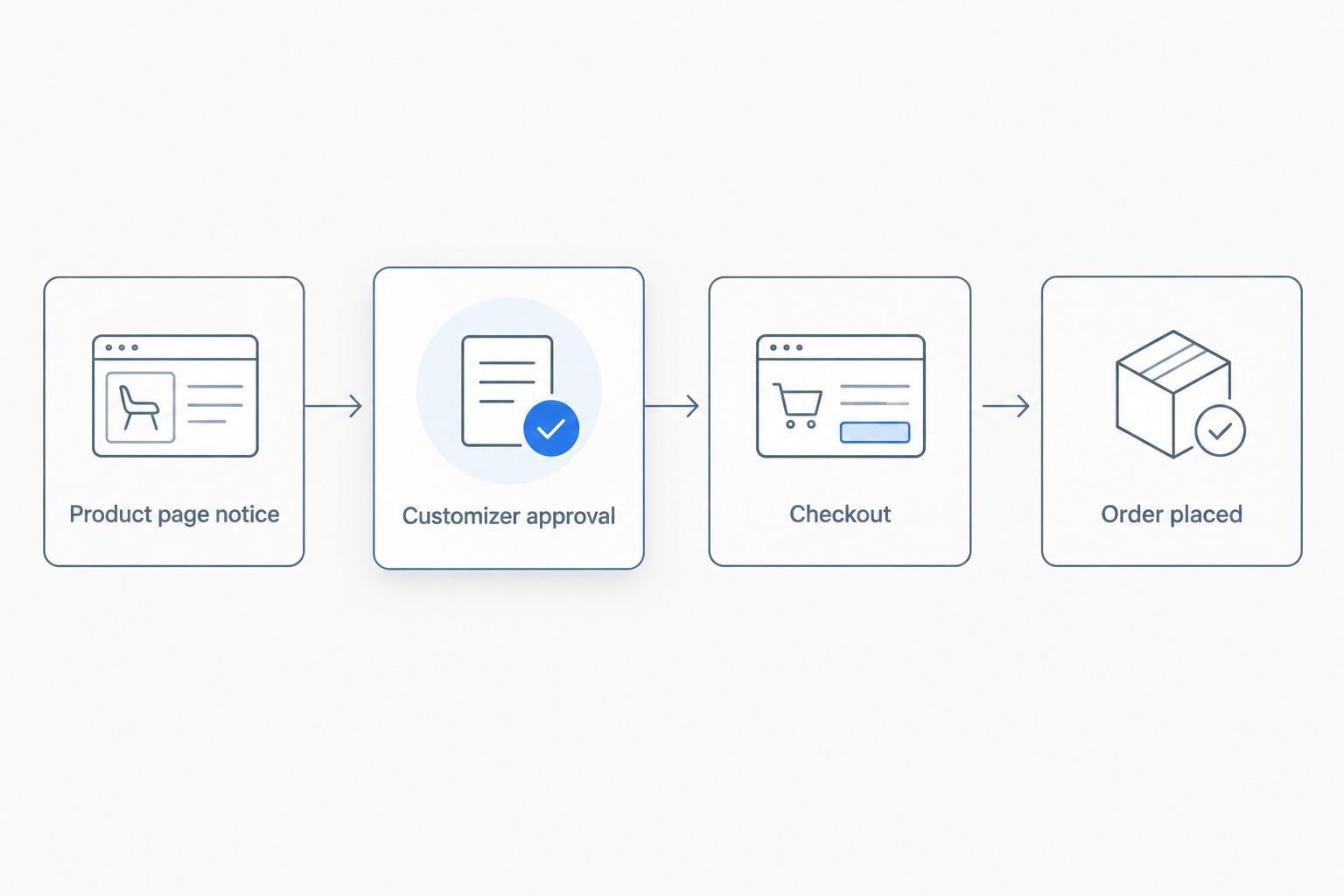
Disclosure that happens before the approval step barely registers as friction.
Some return-management platforms let you flag final sale at the SKU level so personalized items skip the standard return flow automatically. If you're running returns through a dedicated tool, it's worth checking how to flag orders as final sale in Loop Returns so the rule enforces itself instead of relying on a support agent catching it.
Show the final-sale notice where it belongs
Bespo's live-preview customizer puts an approval step right where buyers personalize.
Do personalized items get refunded if there's a production mistake?
Personalized items get refunded when the mistake is the seller's fault — a misspelled name, the wrong color, or a file mix-up — even under a final sale policy. Treating every claim as ineligible regardless of fault is what turns a fair policy into a source of chargebacks.
Should the product page say "final sale" or "non-returnable"?
"Non-returnable, made to order" reads softer than a bare "final sale" label because it explains the reason instead of just stating a restriction. Both terms carry the same practical weight, but the softer phrasing gets less pushback at checkout.
Where should the final sale notice appear on a personalized product page?
The final sale notice belongs directly next to the personalization fields, inside or right under the customizer, not tucked into a footer link. Buyers who see it while typing their name or choosing engraving text treat it as a normal condition of custom work in 2026, not a hidden catch.
FAQ
Can personalized orders be marked final sale in 2026 without hurting conversion?
Yes, personalized orders can be marked final sale in 2026 without hurting conversion when the notice appears before checkout, not after. Buyers accept it the same way they accept non-returnable engraved or monogrammed goods, as long as they see it while personalizing.
Is final sale the same as no refunds for personalized products?
Final sale usually means no returns for buyer's remorse, but sellers still refund production mistakes like misspelled names or the wrong color. Blocking every claim regardless of fault drives chargebacks instead of preventing losses.
What happens if a personalized order arrives damaged?
A damaged personalized order should be replaced or refunded regardless of final-sale wording, because damage is a shipping or production failure, not buyer's remorse. Final sale exists to block change-of-mind returns, not defects.
Should final sale wording say final sale or non-returnable?
Non-returnable, made to order reads softer than final sale because it explains the reason instead of stating a bare restriction. Both carry the same practical meaning, but wording changes how buyers react to it.
Can a customer cancel a personalized order before production starts?
Most personalization workflows allow cancellation up until the design or file is approved for production, even under a final sale policy. Once a proof is approved and sent to production, the item is locked in.
Does marking orders final sale reduce chargebacks?
Final sale wording alone doesn't reduce chargebacks; a visible proof-approval record does, because it shows the buyer confirmed the exact design before it was made. That approval record is what card networks weigh in a dispute.
Should final sale apply to every personalization type?
Final sale can apply to any personalization type, but disclosure and proof-approval matter more for engraving and embroidery, where mistakes are harder to unmake. Print-based personalization is cheaper to redo, so some sellers keep a narrower exception there.
One last thing
The merchants who run final sale without conversion damage in 2026 all do one specific thing: they put the notice on the same screen as the "Approve design" button, not on a separate policy page. That single placement change is worth more than any amount of legal wording, because it converts final sale from a hidden restriction into something the buyer actively agreed to seconds before checkout.