
The blog
How Much to Charge for Personalization in 2026


Product personalization pricing in 2026 isn't one number — it's a formula. Merchants charge either a flat surcharge, a percentage markup on the base item, or a tiered fee that scales with how complex the technique is, and the right choice depends on your catalog spread, not on what a competitor charges.
Whatever method you pick, the surcharge has to cover the added material, machine or labor time, and the reprint risk personalization creates — then leave margin on top. Cost-plus pricing, not a guess. The mistake most stores make in 2026 is charging the same flat fee across a catalog that runs from a low-cost item to a premium one, which either erases margin on the cheap end or looks steep on the expensive end.
TL;DR
- Personalization pricing works as a formula in 2026 — flat surcharge, percentage markup, or complexity tier — not a fixed dollar figure.
- The surcharge needs to cover material waste, machine or labor time, and reprint risk before margin gets added on top.
- Percentage-based pricing scales better across catalogs with mixed price points than a single flat fee.
- Bespo's live-preview customizer applies option-level pricing rules automatically, so the surcharge updates the moment a shopper changes technique or complexity.
Why this matters
Personalization now shows up across jewelry, apparel, drinkware, home goods, and corporate gifting, so a pricing miss compounds fast once it's live across dozens of variants. Price the surcharge too low and every embroidered, engraved, or monogrammed order quietly eats into margin. Price it too high and shoppers abandon the customizer before they finish choosing options.
The fix isn't guessing at a number — it's building a rule that scales with the item and the technique. The guide on pricing personalized products by variant walks through setting different surcharges per variant instead of one blanket rate across the whole catalog.
How much should you charge customers for product personalization?
There are three models merchants actually use in 2026, and each fits a different kind of catalog.
Flat surcharge
- How it works: A fixed add-on charged per personalized item
- Best for: Single-category stores where items sit close in price
- Watch out for: Erodes margin on premium items, feels arbitrary on cheap ones
Percentage markup
- How it works: A percent of the base item's price added at checkout
- Best for: Catalogs spanning multiple price points
- Watch out for: Needs a cap on high-ticket items or the surcharge looks excessive
Complexity tiers
- How it works: Surcharge scales with the technique — a single initial versus multi-color embroidery versus a full-panel print
- Best for: Stores offering more than one personalization technique
- Watch out for: Requires option-level pricing rules, not one rate for the whole product
Best for most catalogs with mixed price points: percentage markup, capped at a ceiling for your highest-ticket items. It's the model that scales without needing a manual price review every time a new SKU launches.
Why personalization surcharges vary
The number itself is less important than what's driving it. Six factors move the surcharge up or down:
- Technique complexity — a single monogram costs less to produce than multi-thread embroidery digitizing
- Material waste — embossing and debossing scrap differently than direct print or engraving
- Production time per unit — hand-finished techniques take longer than automated ones
- Reprint and error risk — a misspelled name means redoing the whole unit, not issuing a partial refund
- Order volume — bulk and corporate orders spread setup cost across more units
- Proof approval steps — a workflow requiring customer sign-off before production adds handling time to the surcharge calculation
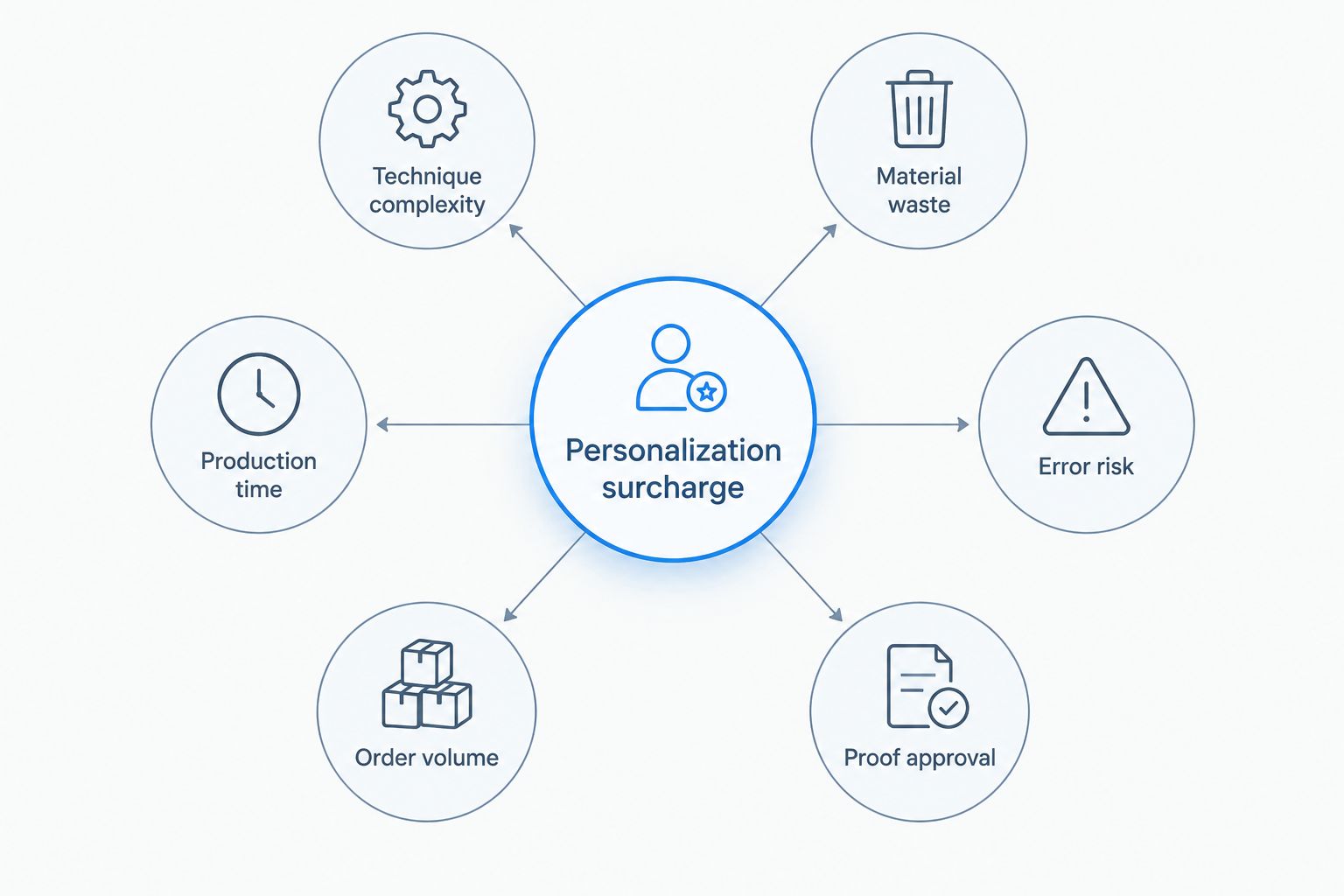
Order volume and proof approval swing the surcharge as much as the technique itself.
How to calculate your personalization surcharge
- Add up your true added cost per unit — extra material, machine or labor minutes, and a buffer for your actual error rate.
- Apply a markup to that added cost, not to the base item price alone. Cost-plus pricing means the margin sits on top of what personalization actually costs you to produce.
- Decide the display format — a flat add-on line item or a percentage applied at the option level.
- Test the surcharge against a real production cycle in 2026 before locking it in storewide. A rate that looks right on paper can be off once shoppers start picking the most time-consuming options.
- Automate the option-level price change so the customizer applies it consistently instead of relying on a spreadsheet someone forgets to update.
A Shopify personalization app like Bespo applies these rules at the option level automatically — a shopper moving from a name print to a full multi-color monogram sees the price update instantly, without a manual price edit on your end.
Should you charge more for engraving than for printing?
Engraving usually costs more to produce than digital printing because it's slower per unit and carries higher reprint risk if the material is scored incorrectly. The actual surcharge should follow your machine time and error rate rather than the technique's reputation for being premium — see how much custom engraving adds to production cost for the specific cost drivers behind that number.
Do bulk or corporate orders get a different personalization price?
Yes — bulk and corporate orders typically carry a lower per-unit surcharge because setup cost, like digitizing a logo or prepping a template, gets spread across many units instead of one. Structuring that as a tiered discount tied to order volume protects margin on small orders while staying competitive on large corporate gifting runs.
Does personalization pricing affect average order value?
Personalization is one of the more reliable ways to lift order value because shoppers pay the surcharge on top of the base item instead of trading down to a cheaper one to stay in budget. The surcharge itself has to be visible before checkout, though — a surprise price at the cart is what kills conversion, not the mark-up on its own.
Set your surcharge rules once
Bespo applies pricing per personalization option automatically as shoppers customize.
FAQ
What's the most common way to price product personalization in 2026?
Percentage markup on the base item's price is the most common approach for catalogs spanning multiple price points in 2026, since it scales automatically instead of needing a manual review per SKU. Flat surcharges still work for single-category stores with items close in price.
Is it okay to charge one flat fee across every personalization option?
A single flat fee only works when every personalized item costs roughly the same to produce. Once techniques vary — a simple text field versus a full-panel embroidery design — a flat fee either overcharges the simple option or undercharges the complex one.
Should the personalization surcharge show before or after checkout?
The surcharge should show on the product page as the shopper builds their customization, before they reach checkout. Surprise pricing at checkout is what drives cart abandonment, not the surcharge itself.
Do handmade personalization techniques cost more to price than digital ones?
Handmade or hand-finished techniques generally take longer per unit than automated digital printing, which pushes the labor-time component of the surcharge higher. The exact number depends on your actual production time, not the technique's category.
Can you change a personalization surcharge after launching it?
Yes, and you should if your real reprint rate or production time turns out different from what you estimated. Review the surcharge against actual order data after a full production cycle rather than locking it in permanently at launch.
Is percentage-based pricing better than a flat fee for personalization?
Percentage-based pricing is generally better for any catalog with more than one price point, since it scales the surcharge with the item's value automatically. A flat fee works fine only when your catalog sits in a narrow price band.
How does order volume change the personalization price?
Higher order volume lets you lower the per-unit surcharge because one-time setup costs, like digitizing a logo, get spread across more units. Tiered bulk pricing tied to quantity captures this without discounting single-unit orders.
Does a live-preview customizer affect how you price personalization?
A live-preview customizer lets you attach pricing rules to individual options rather than the product as a whole, so a shopper choosing a more complex technique sees a higher price update in real time. Without that, most stores fall back to one flat rate that under- or overcharges depending on what's actually selected.
One last thing
Run a new surcharge as a limited test on a handful of variants before rolling it out storewide in 2026. The rate that looks right on a spreadsheet often breaks the moment real shoppers start picking the most labor-intensive option in the customizer — the one nobody modeled for when the number was set.