
The blog
Bulk personalised orders: Discount if profitable (2026)


Yes, it is worth offering a discount for bulk personalised orders in 2026 when the extra contribution from the order exceeds the margin you give up. A larger order does not automatically cost less to fulfil: different names, designs and approval steps can add work for every unit. Base the offer on the buyer’s final specifications, not quantity alone.
TL;DR
- Is it worth offering a discount for bulk personalized orders? Yes, when the order stays profitable after personalisation work.
- One shared design is a stronger discount candidate than a different design on every unit.
- Bespo suits Shopify merchants who need live personalisation previews and production-ready files, not a substitute for margin checks.
- Set the discount after confirming artwork, variations, approvals and fulfilment work.
Why this matters
A bulk order can look attractive while leaving you with more production work than expected. The buyer sees a quantity of products; your team has to account for the personalisation on each one. Use the tiered discounts for bulk personalised orders guide to plan how an approved offer appears on Shopify. First, decide whether the order earns a discount at all.
The distinction matters in 2026 because a quantity break answers only one question: how many items does the buyer want? It does not tell you whether those items share artwork, need individual text, require separate proofs or create extra production steps. Those details determine what you can afford to give up.
Is it worth offering a discount for bulk personalised orders?
Offer a discount when shared setup work or a larger confirmed order leaves enough contribution to cover the reduction. Keep your usual terms, or prepare a custom quote, when the buyer wants extensive variation and the work is unclear. The right decision follows the order specification.
No automatic discount
- Best for: Orders with extensive individual personalisation
- Advantage: Protects margin until the work is clear
- Drawback: Adds a decision before you can close a bulk request
- Verdict: Use when specifications vary.
Fixed quantity discount
- Best for: Repeatable orders with the same personalisation work per unit
- Advantage: Gives buyers a clear rule
- Drawback: Can reduce margin on labour-heavy orders
- Verdict: Use only after checking unit economics.
Custom bulk quote
- Best for: Orders mixing products, artwork or approval requirements
- Advantage: Lets you account for the full job
- Drawback: Takes longer to prepare than a published rule
- Verdict: Use for complex requests.
Do not treat that table as a ranking from worst to best. A fixed rule is useful for a repeatable job and risky for an undefined one. A custom quote gives you room to scope the work, but it also puts another step between the buyer and an accepted order. Choose the least complicated approach that still covers the actual production work.
For a 2026 decision, compare the contribution from the proposed bulk order with the contribution you would retain under your normal terms. Account for the product, personalisation work, packaging, fulfilment and any extra coordination the request creates. If the buyer has not confirmed the details that drive those costs, you do not have a basis for a firm discount.
How to decide before you make an offer
Start with the job, not the requested quantity. Ask the buyer to define what changes between units and what stays the same. Then work through these steps:
- Confirm the product and technique. Embroidery, engraving, print and other methods involve different production work. Do not assume a discount that works for one technique works for another.
- Count distinct designs, not just units. One design repeated across an order is a different job from individually personalised items. Identify every name, message or artwork variation you must handle.
- Define the approval work. Establish who supplies the content, who approves the final version and whether approval happens once or for each variation.
- Calculate contribution under the proposed terms. Subtract the costs of fulfilling the specified order from the amount the buyer will pay. Compare the result with your minimum acceptable contribution for that work.
- Put the scope in the offer. State which products, variations and approval steps the offer covers. If the request changes, reassess the terms before confirming it.
A discount should be the result of that calculation, not a substitute for it. If your cost depends on information the buyer has not supplied, request the missing specifications. That is more useful than publishing a broad quantity break and finding out later that every item needs separate attention.
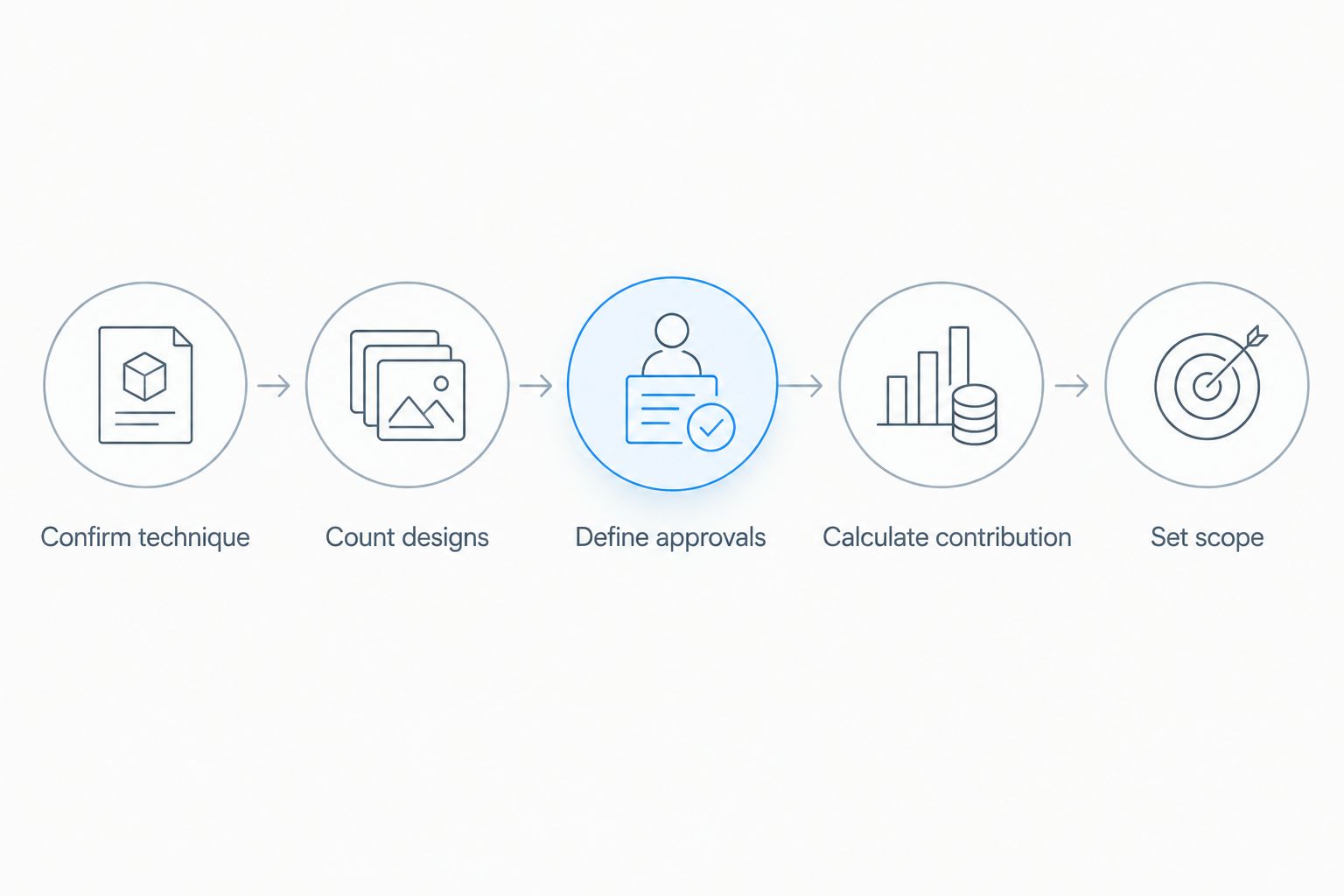
Confirm what varies between units before deciding whether the order earns a discount.
Bespo is best for Shopify merchants who need live personalisation previews and production-ready files, not a substitute for margin checks. Its role is to help shoppers specify personalised products and give fulfilment a usable output. You still need to decide which bulk requests meet your contribution target.
Why bulk discount value varies
A request for personalised products carries two separate workloads: making the products and managing the information needed to personalise them. Check these factors before applying the same rule to every order:
- Shared versus individual content. Repeating one design keeps the specification simpler than collecting different names or messages for each unit.
- Personalisation technique. Do not group embroidery, engraving, embossing, debossing and print into one cost assumption. Assess the work for the technique in the request.
- Number of design variations. Variations need to be captured accurately and matched to the correct items. Quantity alone does not describe that task.
- Approval requirements. A shared design can have a single approval path; individual variations introduce more material for someone to check. Confirm the buyer’s process before quoting.
- Production handoff. The order must give fulfilment the right information for each item. Include the work of preparing and checking that handoff in your decision.
- Changes after approval. Define how you will handle changes to names, artwork or quantities. A discount agreed for one scope should not silently extend to a different job.
These are decision inputs, not reasons to refuse every bulk request. If the buyer can supply clean, final specifications and the work remains repeatable, an offer can make sense. If each unit needs a separate decision, protect time for that work. The practical question is not whether bulk is good; it is whether this bulk specification leaves enough contribution.
When a fixed discount works—and when it does not
A fixed quantity rule works best when you can describe the eligible order without exceptions. The product, technique and personalisation scope should be clear enough that another member of your team can apply the same rule. That clarity helps the buyer, too: they can tell what they need to submit before you confirm the offer.
The upside is a simpler buying decision. The downside is that a rule based only on unit count cannot recognise extra design or approval work. If a buyer can enter entirely different content for every unit, a fixed discount might reward the order that takes the most effort to process. Restrict eligibility to the scope you have costed, or use a quote instead.
A custom quote is the better 2026 choice for mixed products or unclear artwork. It gives you a place to confirm specifications before agreeing to terms. Its cost is friction: the buyer must wait for an answer rather than applying a published rule. Keep the quote process focused by asking only for details that change production work or contribution.
No automatic discount is also a valid policy. It avoids reducing contribution merely because an order is large. The trade-off is that a buyer seeking a bulk arrangement needs a clear path to request one. State that the terms depend on the final specification instead of implying that every quantity qualifies.
What should you ask a bulk buyer first?
Ask whether every item uses the same design. That answer changes how you assess the job more than the headline unit count does. Follow it with the product, technique, content variations and approval contact. You need enough information to distinguish a repeatable run from a collection of individual custom orders.
For corporate gifting, ask whether one person will provide and approve the complete list of names or designs. Do not assume that a corporate order has shared artwork. For a storefront order, make sure the buyer knows which details must be final before the offer can be confirmed. An incomplete specification is a reason to pause the decision, not a reason to guess at the workload.
Can you discount items with different names?
Yes, if the contribution still covers the work of handling each name. Different names do not automatically rule out a bulk offer. They do change the specification: you need accurate content for each item and a way to match it to the right product.
In 2026, assess that order against its actual variation and checking work. If the buyer supplies final content in a form your fulfilment process can use, you can evaluate the request. If names are still changing, hold the terms until the scope is stable. The discount decision should follow the confirmed job, not an early estimate of it.
Should bulk personalisation use a quote instead?
Use a quote when a fixed rule cannot account for the variations or approvals in the request. A quote makes the scope explicit before you agree to a reduction. It also gives you a clear basis for reassessing the offer if the buyer changes the design or quantity.
Keep the buyer’s next step simple: request the product, quantity, technique, design variations and approval requirements. Avoid asking them to complete a full production brief merely to find out whether you will consider the order. Collect what you need to make the decision, then confirm the remaining details before fulfilment.
If you accept quote requests through Shopify, draft order quotes for custom Shopify B2B requests is the related guide to review. Bespo handles live product personalisation and production-ready files; it does not decide which quote meets your margin target. Keep that decision with the merchant.
FAQ
Is it worth offering a discount for bulk personalized orders?
Yes, when the confirmed order remains profitable after the discount and all personalisation work. Check design variations, approvals and fulfilment before offering it.
Does a bigger personalised order always cost less to produce per item?
No. Individual names, designs or approval steps can add work even when the unit count rises. Assess the final specification rather than quantity alone.
Should I discount a bulk order with a different name on every item?
Discount it only if the contribution covers handling and checking every name. Confirm the complete list and how it maps to each product before agreeing to terms.
Is a fixed discount or a custom quote better for bulk personalisation?
A fixed discount fits a repeatable, clearly defined order; a custom quote fits mixed or uncertain specifications. Both have a trade-off: fixed rules can overlook work, while quotes add a buying step.
What should I confirm before quoting a corporate gift order?
Confirm the product, quantity, technique, design variations and approval contact. A corporate buyer may request either shared artwork or individual personalisation, so scope the actual job.
Can Bespo set the right bulk discount for my Shopify store?
Bespo provides live personalisation previews and production-ready files for Shopify merchants. Set the discount from your own order costs and contribution target.
When should I hold off on offering a bulk discount?
Hold off when artwork, names or approval requirements are still changing. Confirm the scope before you commit to terms based on incomplete information.
One last thing
The most useful bulk-order question is whether the work repeats—not how many units the buyer wants. In 2026, make design variation and approval scope part of the discount decision. An order with a clear, repeatable specification gives you something you can calculate; an undefined one calls for a conversation before an offer.