
The blog
Same-Day Personalization for Pickup: Worth It? 2026


Yes—offer same-day personalization for local pickup when you control production, can complete the work before collection, and retain margin after the extra handling. Keep it limited to tested designs and a capped production queue. Pickup removes the delivery journey, not the time needed for personalization, quality checks, and packing.
TL;DR
- Is it worth offering same-day personalization for local pickup? Yes, when tested production capacity supports the promise.
- Keep Shopify local pickup separate from production readiness; tell customers when their personalized order is ready.
- Bespo supports Shopify personalization with live previews and production-ready files, not a same-day production guarantee.
- Start with controlled designs; expand only after reviewing completed orders, rework, and margin.
Is it worth offering same-day personalization for local pickup?
Offer it as a controlled service, not a blanket promise across your catalog. The right decision depends on the complete order journey: receiving the design, checking it, producing the item, inspecting it, and preparing the handoff.
Use the following comparison to choose your starting model. These are operating choices, not measured performance benchmarks.
Limited same-day personalization
- Best for: Merchants with tested templates and direct production control
- Main benefit: A clear collection deadline for eligible orders
- Main drawback: Requires a protected queue and firm acceptance rules
- Recommendation: Start here if your workflow passes testing
Same-day service after manual review
- Best for: Merchants handling designs that need inspection
- Main benefit: Staff check feasibility before accepting the deadline
- Main drawback: Customers wait for confirmation
- Recommendation: Use for exceptions, not routine orders
Standard personalized local pickup
- Best for: Merchants with variable production or external fulfillment
- Main benefit: Collection without a same-day commitment
- Main drawback: Does not meet an urgent collection need
- Recommendation: Keep this as the fallback
For your 2026 launch, choose the narrowest model your team can deliver consistently. The guide to handling rush orders for personalized Shopify products covers the adjacent workflow.
Why this matters
Same-day pickup changes the promise you make. A customer ordering for an event needs a finished item, not an order that has entered production.
Treat the deadline as an acceptance condition. Before confirming it, check whether the design is complete, the production route is suitable, and the team has room to finish the work.
The commercial test is equally direct: does the order contribute enough after personalization, packing, customer communication, and collection handling? Revenue alone does not answer that question. A service that repeatedly interrupts other work needs a different scope, even when customers request it.
What should qualify for same-day personalization?
Qualify the design and workflow together. Do not label an entire personalization technique same-day simply because a sample completed quickly.
An engraving job with an approved text template is a different production task from an engraving job requiring artwork repair. The same distinction applies to embroidery, monograms, embossing, debossing, and print: the technique name does not establish the deadline.
Create eligibility rules that staff can apply without improvising:
- Defined design choices: Offer layouts, text placement, and options you have already tested.
- Complete instructions: Require the exact text, capitalization, and selected design before acceptance.
- Known production route: Confirm how the order moves from customer choices to the production file and finished item.
- Inspection access: Leave room to check the result before the collection deadline.
- Clear handoff: Assign responsibility for packing, readiness communication, and collection.
Exclude any request that needs an unresolved design decision. Give that customer the standard personalization route instead. A narrower promise is easier to explain than a missed deadline.
For 2026, write eligibility around what your team can finish—not around the broadest range of options your storefront can display.
Why same-day personalization feasibility varies
The deciding factors sit between the customer's design and the finished order. Review these before adding the service to a product page:
- Design preparation: Customer text in an approved layout and artwork needing edits create different workloads. Route unfinished designs to review.
- Production method: Setup, processing, and finishing requirements differ by technique. Measure the complete workflow for each eligible product.
- Queue pressure: Accepted orders compete for people and equipment. Base acceptance on committed work, not an empty-queue demonstration.
- Approval requirements: An order awaiting a customer decision is not ready for production. Define when approval must be complete.
- Quality control: A deadline must leave space to inspect and correct the work. Do not treat inspection as optional rush time.
- Collection handling: Packing, customer messages, and the physical handoff also consume staff attention. Include them in the service plan.
None of these factors justifies a universal turnaround claim. Your own completed-order records should determine the promise you publish.
How do you set up a controlled same-day pickup workflow?
Build the service around a visible sequence. Each stage needs an owner and a clear condition for moving the order forward.
Define eligibility
Choose products and personalization layouts that your team has already produced successfully. Document which customer choices are accepted and which require review.
Avoid launching every design option at once. A controlled starting scope makes it easier to identify where work slows down.
Check the design
Confirm the spelling, capitalization, placement, and selected options. Where the production method needs artwork preparation, resolve that before accepting a same-day deadline.
Keep the final customer instructions attached to the production record. Do not make staff reconstruct the design from separate messages.
Reserve capacity
Check committed work before accepting another same-day order. Include setup, finishing, inspection, packing, and the collection handoff—not just machine time.
Set an acceptance cutoff from your measured workflow. The cutoff must leave enough working time to complete every remaining stage.
Produce and inspect
Use the approved instructions for production. Check the finished item against those instructions before packing it.
If it fails inspection, resolve the problem before sending a ready message. An order marked complete in a queue is not proof that the item is ready to collect.
Confirm collection
Send the readiness notification only after the order has passed inspection and is packed. Include the collection location and applicable collection instructions.
Assign someone to manage the handoff. The customer should not need to explain their personalization choices again at collection.
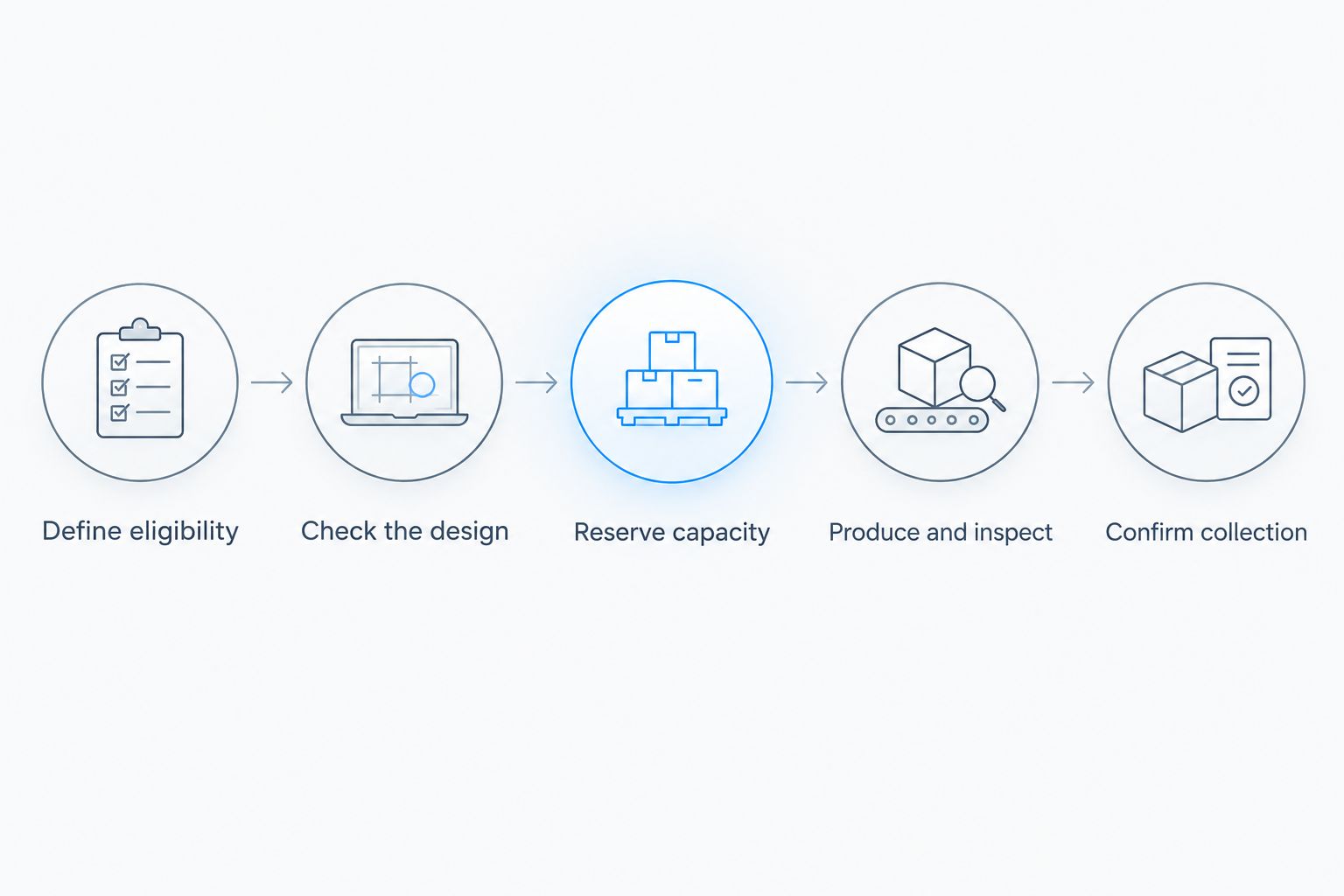
Accept the deadline only after checking both the design and the production queue.
For your 2026 setup, test the entire sequence before publishing the promise. Include customer communication and collection handling in the test, not just production.
Where does a Shopify personalization app help?
A personalization app addresses the customer's design choices and their handoff to production. It does not replace the production schedule, inspection, or collection process.
Bespo is a Shopify personalization app with a live-preview customizer and production-ready file output. Merchants can add personalization without developer involvement, including embroidery, engraving, monograms, embossing, debossing, and print.
Bespo is best for Shopify merchants who need live personalization previews and production-ready files without developer involvement. That is relevant when your same-day workflow depends on receiving clear customer choices before production begins.
The benefit is a storefront-to-production design workflow. The limitation is physical execution: Bespo does not establish how quickly your team completes an item, whether the item passes inspection, or when a customer can collect it. Keep those decisions in your operating process.
How do you know whether the service is worth keeping?
Record what happens after acceptance. A launch decision is not enough; the service needs a repeatable review using your own orders.
Track the following for each eligible order:
- Whether it met the promised readiness deadline.
- Staff time spent on design checks, production, packing, and handoff.
- Rework and the reason it occurred.
- Customer messages needed to resolve missing or unclear instructions.
- Contribution after the work required to complete the order.
- Any standard orders delayed by accepting the rush job.
Compare similar work. A repeat text layout and a design requiring manual edits do not provide a useful like-for-like timing comparison.
For your 2026 review, keep the service when completed orders support both the deadline and the contribution you need. Narrow it when particular designs create repeated exceptions. Stop accepting same-day work when fulfilling the promise depends on disrupting commitments already made to other customers.
Do not expand the service based on order count alone. Expand only when the complete workflow remains manageable.
What should you tell customers before they order?
Put the service conditions near the personalization choices. Do not leave the production deadline to a general pickup explanation elsewhere on the store.
Your customer-facing instructions should explain:
- Which personalization choices qualify for the service.
- When complete design instructions must be submitted.
- Whether staff must confirm eligibility before accepting the deadline.
- What happens if the design needs changes or approval.
- That collection begins after a ready notification.
- Where the customer collects the finished order.
Use language your team can enforce. If acceptance requires review, say so before purchase rather than presenting the deadline as automatic.
Keep order receipt and pickup readiness distinct. Receipt confirms that the order reached your store; readiness confirms that the finished item has passed your checks.
Can you offer same-day personalization with external fulfillment?
Do not promise same-day local pickup unless the production and handoff arrangements support it. An external production partner adds a dependency you must confirm before accepting the deadline.
Check the partner's actual production commitment and how the finished item reaches the collection point. A file sent successfully is not a finished order, and a completed item elsewhere is not ready at your pickup location.
If those arrangements do not support the promise, offer standard personalized pickup. Keep the customer-facing deadline aligned with the process you control.
Should you accept custom artwork for same-day pickup?
Accept custom artwork only after confirming that it is ready for the intended production method. Treat artwork repair, layout changes, and unresolved approvals as separate work—not invisible steps inside the deadline.
A preview helps customers review appearance, but production suitability still needs the appropriate check. Keep orders requiring that check on a review-based route until staff confirm acceptance.
For a first launch, favor approved templates over unrestricted design requests. Add broader choices after testing their complete production workflow.
What happens when a customer changes the design?
Recheck the deadline whenever the approved instructions change. A change to text, layout, or artwork creates a new production decision, even if the customer describes it as small.
Before production starts, confirm the final instructions and whether the original collection promise still holds. After production starts, explain what work has already happened and what the change requires.
Give staff a clear escalation rule. Do not leave the decision to whoever happens to read the customer's message.
FAQ
Is it worth offering same-day personalization for local pickup in 2026?
Yes, when tested production capacity supports the deadline and the order retains margin after handling. Start with defined designs and keep standard personalized pickup as the fallback.
What's the best way to start same-day personalized pickup?
The best starting model is a limited service using tested products and approved templates. Check the complete workflow before expanding the design choices.
Does choosing local pickup mean a personalized order is ready today?
No, local pickup does not establish production readiness. Tell customers to wait for confirmation that their finished order is ready to collect.
Can Bespo guarantee same-day personalization?
No same-day production guarantee is established for Bespo. The Shopify personalization app provides live previews and production-ready files; your production and collection process determines readiness.
Should I accept customer artwork for same-day personalization?
Accept customer artwork only after checking its suitability for the intended production method. Requests needing edits or approval belong on a review-based route before a deadline is confirmed.
How do I choose a same-day personalization cutoff?
Choose the cutoff from your measured end-to-end workflow and committed queue. Allow working time for design checks, production, inspection, packing, and readiness communication.
What should I measure before expanding same-day pickup?
Measure deadline performance, staff time, rework, contribution, and disruption to existing orders. Expand only when completed orders support the full service promise.
One last thing
Your acceptance rule matters as much as your production speed. A fast production step cannot rescue an order accepted with incomplete instructions or an unresolved design.
For 2026, give staff a stop rule: do not accept the same-day deadline until the design and remaining workload both pass review. Then make the next action clear—accept the order, request clarification, or offer standard pickup.