
The blog
Is Monogramming Worth It as a Paid Upsell in 2026?


Monogramming is worth adding as a paid upsell for Shopify stores selling apparel, bags, towels, drinkware, or gifting products in 2026 — shoppers already expect to pay more for a name or initials, and the upsell adds zero extra inventory. The catch: it adds a manual production step, so the upsell only pays off when checkout sets a realistic turnaround and your fulfillment process can absorb the extra step without slowing down every other order.
TL;DR
- Monogramming works as a paid upsell for apparel, bags, drinkware, and gifting SKUs — skip it on commodity products where shoppers compare on price alone.
- Deloitte's 2019 personalization survey found 1 in 5 consumers would pay 20% more for a customized product, and monogramming is the cheapest form of that customization to deliver.
- The main risk isn't demand, it's fulfillment: a manual embroidery or engraving step slows production if it's bolted onto an existing workflow late.
- Bespo lets Shopify merchants add a priced monogramming option with live preview, without touching code or hiring a developer.
- Charging for monogramming from launch avoids the awkward 'why is this suddenly not free' conversation later.
Why this matters
An upsell only earns its place on a product page if it lifts order value without adding cost you can't recover. Monogramming clears that bar for a specific set of products — apparel, bags, towels, drinkware, gifting items — because the labor is small, the perceived value is high, and the customer is already emotionally invested in the purchase. It fails on commodity products where the buyer is price-shopping, because a paid add-on just gives them a reason to compare you against a competitor who doesn't charge for it.
Corporate gifting and DTC gifting brands lean on this heavily going into 2026: a monogrammed item reads as a finished gift, not a raw product, and buyers pay for that finish. Bespo exists specifically to let Shopify merchants add that kind of real-time personalization — embroidery, engraving, monograms, embossing, debossing, print — without a developer build.
Is monogramming worth adding as a paid upsell?
Yes, for the right catalog. The comparison below breaks down the three ways merchants typically handle it.
Charge for monogramming
- Upside: Recovers labor cost, signals premium positioning
- Downside: Some cart abandonment from price-sensitive shoppers
- Best for: Apparel, bags, drinkware, gifting brands
- Verdict: Buy
Offer it free
- Upside: Removes a purchase friction point, can lift conversion
- Downside: Absorbs labor cost across every order, hard to walk back later
- Best for: Low-volume or high-margin luxury items
- Verdict: Hold
Don't offer it
- Upside: No added fulfillment complexity
- Downside: Leaves AOV and differentiation on the table
- Best for: Commodity products, thin-margin categories
- Verdict: Skip
The middle option — free monogramming — isn't automatically wrong, but it needs margin room the average store doesn't have. If you're weighing that path, the breakdown in how much to charge for product personalization covers where the line usually sits between free and paid.
How to launch it without slowing production
- Pick the products where personalization fits the buyer's intent — gifts, apparel, drinkware, not raw materials or bulk commodities.
- Set the fee at checkout, not as a surprise upcharge at cart — customers accept a listed price far more easily than a late addition.
- Give shoppers a live preview of the monogram before they buy, so proof requests and back-and-forth emails drop.
- Route personalized orders into a separate production queue so a slow monogram job doesn't hold up standard shipments.
- Confirm your app can output a production-ready file automatically — hand-typing initials into a design tool for every order doesn't scale past a few dozen a week.
Setting this up manually across theme code, checkout, and fulfillment is the part that stalls most merchants. The step-by-step in set up monogramming on Shopify product pages covers the app-embed and customization-block route that skips the developer build entirely.
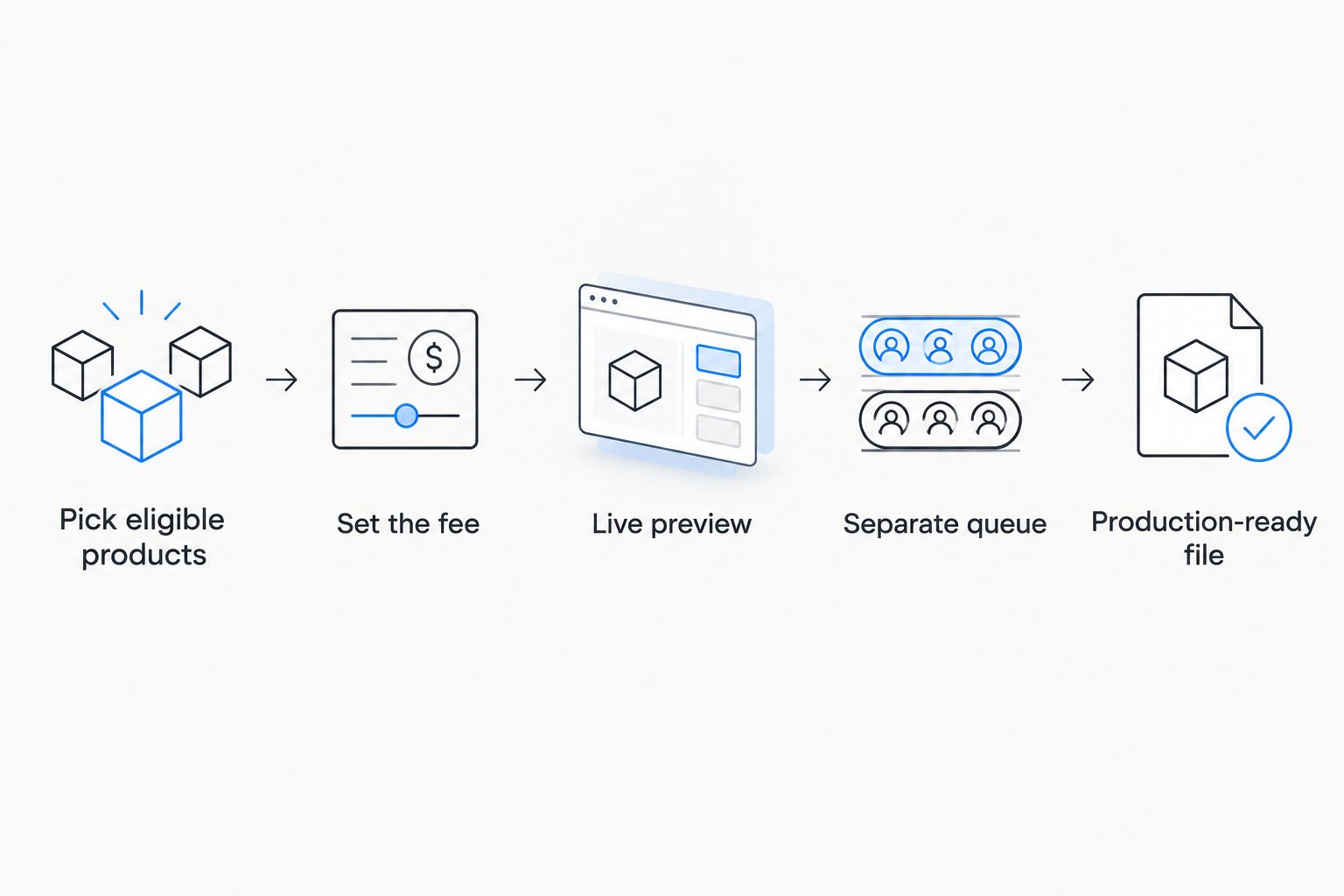
The fee and the preview both happen before checkout, not after.
Why the case for charging varies
Not every store gets the same return from a monogramming fee. The factors that move the answer:
- Product category fit — apparel, bags, towels, and drinkware carry higher willingness to pay than raw or functional goods.
- Order volume — a store doing a handful of personalized orders a week can absorb manual steps; a high-volume store needs automated file output or the queue backs up.
- Technique complexity — embroidery and engraving take longer to produce than a printed initial, which changes both the fee and the turnaround promise.
- Channel mix — corporate gifting and B2B buyers expect to pay for personalization; impulse DTC buyers are more price-sensitive about add-ons.
- Existing margin — thin-margin categories need the fee to cover labor; higher-margin gifting brands have room to test free personalization instead.
- Return policy exposure — personalized items are typically final sale, which changes the math on offering the option free versus charging enough to cover a non-returnable SKU.
Should monogramming be free or paid?
Paid monogramming is the right default for most stores in 2026 because it recovers the labor cost of a manual production step without pressuring margin on every order. Free personalization only makes sense when the category has enough margin to absorb it across the full catalog or when it's used as a short-term conversion test rather than a permanent policy.
Does monogramming increase average order value?
Monogramming increases average order value when it's positioned as an add-on rather than a base feature, because the customer is paying extra on top of the item they were already going to buy. The lift depends on how it's presented — a priced option on the product page performs differently than the same option buried at checkout, which is why the post-purchase upsell placement matters as much as the fee itself.
Does charging for it hurt conversion?
Charging for monogramming can lower add-to-cart rate slightly among price-sensitive shoppers, but it rarely hurts overall conversion when the fee is shown early and the value is obvious — a live preview of the name or initials on the product does more to justify the charge than any copy on the page. Stores that hide the fee until checkout see more abandonment than stores that list it upfront.
Launch a priced monogramming option
Add live-preview personalization to Shopify without a developer.
FAQ
Is monogramming worth adding as a paid upsell in 2026?
Yes, for apparel, bags, towels, drinkware, and gifting products — the labor cost is small relative to the price shoppers accept for personalization. It's a weaker fit for commodity products where buyers compare on price alone.
What's the best way to price a monogramming add-on?
Price it to cover the extra production time and show it on the product page before checkout, not as a surprise upcharge. The breakdown in how much to charge for product personalization covers typical pricing logic by product type.
Does offering free monogramming convert better than charging for it?
Free monogramming can remove friction and lift conversion short-term, but it only works long-term in categories with enough margin to absorb the labor cost across every order. Most stores are better off charging from launch.
Should monogramming be a checkout upsell or a post-purchase upsell?
Both placements work, but a checkout-stage upsell with a live preview converts more predictably than a post-purchase offer because the customer sees exactly what they're getting before they commit to paying more.
Can a paid monogramming option slow down fulfillment?
Yes, if it's added to an existing workflow without a separate production queue — a manual embroidery or engraving step will bottleneck standard orders if it isn't isolated. Routing personalized orders separately fixes this before it becomes a shipping-delay problem.
Do customers expect to pay extra for monogramming?
Most shoppers buying gifting or apparel items already expect a monogram or initials to cost more, based on how personalization is priced across mainstream retail. A clearly listed fee rarely surprises them the way a hidden one does.
Is monogramming better suited to DTC or corporate gifting stores?
Corporate gifting buyers accept a paid monogramming fee more readily than impulse DTC shoppers, since gifting purchases are already planned and budgeted. DTC stores still see lift, but the fee needs to be smaller and the preview needs to be instant.
Does a Shopify app make monogramming easier to launch as a paid upsell?
A dedicated personalization app removes the need for custom theme code and outputs a production-ready file automatically, which is the main bottleneck for stores trying to charge for monogramming at any real volume. Without it, most merchants end up manually typing initials into a design tool per order.
One last thing
The part merchants underestimate isn't demand — it's the file handoff. A monogramming upsell that generates orders faster than your team can turn initials into a clean, production-ready file just creates a backlog with your name on the delay, not the customer's.