
The blog
Is print on demand profitable for apparel brands? Yes, 2026


Yes, print on demand can be profitable for apparel brands in 2026 if each order covers production, delivery, payment, customer acquisition and returns costs, with enough left to cover overhead. There is no universal profit margin: a sale can look profitable until you account for the costs of winning and fulfilling it.
TL;DR
- Is print on demand profitable for apparel brands in 2026? Yes, when each order contributes enough to cover overhead.
- A supplier handles on-demand production; your profit still depends on the full cost of each sale.
- Personalisation creates another reason to buy, but its production cost belongs in the margin calculation.
- Bespo is best for Shopify merchants who need live apparel previews and production-ready personalisation files.
Why this matters
Print on demand removes the need to order a run of finished garments before customers buy them. It does not remove the cost of the garment, decoration or fulfilment. For an apparel brand in 2026, the useful question is not whether print on demand works in general. It is whether your specific product leaves enough money after every cost tied to its sale.
A personalised hoodie and a standard printed tee can use the same fulfilment model but have different economics. The customer-facing options differ, and so can the work required to prepare and check an order. If you sell both, calculate their margins separately rather than applying one store-wide figure. The Shopify apparel product customiser guide covers the storefront side of those choices; this page focuses on the profit test.
Is print on demand profitable for apparel brands in 2026?
Yes, when contribution from fulfilled orders exceeds the costs of running the apparel business. Start with net revenue from an order, including any delivery charge the customer pays. Subtract the garment, decoration, fulfilment, delivery, payment processing and any acquisition cost attributable to that order. Account for refunds and replacement work, then check whether the remaining contribution covers fixed costs.
Do not treat the balance after the supplier invoice as profit. That balance has not yet paid for ads, your time, software or the work involved in handling an order that goes wrong. In 2026, the decision is a calculation based on your own orders, not a category-wide margin claim.
Third-party print on demand
- Best for: Testing apparel without ordering finished stock first
- Advantage: Production starts after a customer orders
- Trade-off: You must work within the supplier's product and production terms
In-house decoration
- Best for: Brands equipped to manage production themselves
- Advantage: Direct control over the decoration workflow
- Trade-off: You take on equipment, materials and production work
Print on demand with storefront personalisation
- Best for: Brands offering names, initials or customer-selected text
- Advantage: Shoppers can specify their design before checkout
- Trade-off: Each option needs accurate order data and a workable production process
The table describes operating choices, not a ranking by profit. A third-party supplier can be the right choice even when its unit cost is higher than your in-house production cost, because the in-house option also brings work and overhead. Compare the total economics of the orders you expect to fulfil.
What belongs in the order calculation?
Use the same set of entries for every apparel product you assess. That makes a standard tee and a personalised hoodie comparable without pretending they have the same production requirements.
- Net order revenue: Record what the business keeps from the order, including customer-paid delivery and after any refund. Do not count tax collected for remittance as product revenue.
- Garment and decoration: Include the blank and the work needed to print, embroider or otherwise finish the item. Check the actual supplier quote or your own production records.
- Fulfilment and delivery: Count what it takes to prepare, pack and ship the order. If the customer pays a delivery charge, record that charge on the revenue side too.
- Payment and acquisition: Include payment charges and the cost of bringing in the customer where you can attribute it to the sale.
- Corrections and overhead: Account for replacements, refunds, software and the operating work that individual supplier invoices do not capture.
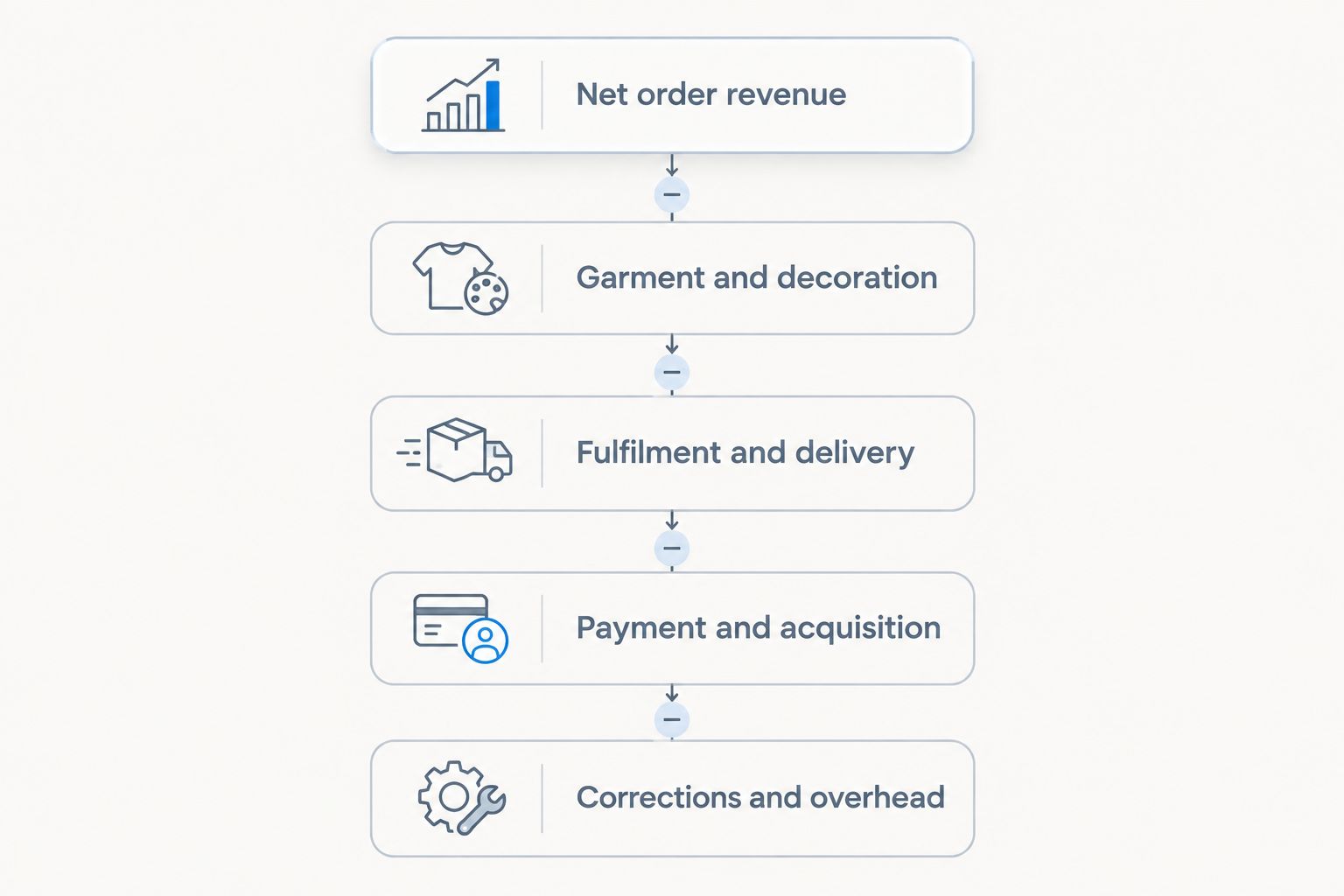
A supplier invoice is only one part of the order calculation.
If an expense is already included in a supplier's charge, do not subtract it again. If you handle packing or design review yourself, do not leave that work out simply because no third party sent an invoice. For a closer look at the production component, use the print on demand cost per unit guide, then add the costs specific to your store.
Which apparel fulfilment model fits your margin?
Third-party print on demand: best for testing demand
A third-party provider produces apparel after an order is placed. That lets you test a garment or design without committing to a run of finished items. Use it when avoiding an upfront production commitment matters more than controlling each production step.
The limitation is control. Your calculation has to use the provider's actual quote and terms for the garment and decoration you intend to sell. A healthy-looking margin on one blank tells you nothing about a different garment or technique. In 2026, compare the specific products in your catalog rather than treating print on demand as a single cost category.
In-house decoration: best for brands ready to run production
In-house decoration puts the production process under your control. You can decide how to prepare orders and schedule the work. Choose it only after accounting for the equipment, materials and labour the process requires.
A lower direct cost for a printed garment does not, by itself, make this model more profitable. Equipment and production work must be paid for by the orders you fulfil. If you are comparing an in-house workflow with a supplier quote, give both models the same accounting treatment: include the work and overhead associated with each.
Personalised apparel: best for products customers help specify
Names on team apparel, initials on accessories and shopper-selected text give buyers choices that a fixed design does not. Those choices also create production instructions that must reach whoever makes the garment. Offer personalisation when the customer experience and production process both support it, not as an assumed margin boost.
Bespo is a Shopify personalisation app for merchants who want shoppers to see a live preview and send production-ready files into fulfilment. Bespo is best for Shopify merchants who need live apparel previews and production-ready personalisation files. The app addresses how a customer specifies an item; you still need to calculate the cost of making and delivering it. A preview does not turn an unprofitable order into a profitable one.
Why apparel print on demand profitability varies
- The garment changes the base cost. Use the blank you will actually sell in your calculation. A quote for a different item does not establish your margin.
- The decoration changes the work. Printing, embroidery and other techniques have different preparation and production requirements. Confirm what your supplier includes rather than assuming the same cost across techniques.
- Delivery changes the order result. Record both any delivery charge paid by the customer and what fulfilment and shipping cost your business. Looking at only one side distorts the calculation.
- Acquisition changes what remains. A sale that covers production can still fail to cover the amount spent to win that customer. Separate sales acquired through paid campaigns from those with different acquisition costs.
- Personalisation changes the workflow. Customer-entered details need to be captured, checked and passed to production. Count that work even if the garment itself does not change.
- Refunds and corrections change realised revenue. Calculate against what you keep after problems are resolved, not just the amount shown when checkout completes.
These factors apply to your own orders. They do not produce a useful universal percentage for apparel brands. If you have several garments or sales channels, calculate each combination that materially changes a cost or the customer-facing offer.
How do you decide whether to launch a POD apparel product?
- Specify the exact product. Choose the garment, decoration and customer options before requesting a production quote. A generic estimate cannot tell you whether that product works.
- Map the order. Write down what the customer submits, what the producer receives and who checks the details. Include a separate path for an order that needs a correction.
- Record net revenue and variable costs. Use your intended selling terms and actual supplier information. Include the costs that rise when another order comes in, not just the print charge.
- Account for acquisition and fixed work. Decide how you will attribute customer acquisition, then check whether the contribution left by orders can support software and operating costs.
- Test before expanding the catalog. Review the completed orders for that product. Replace assumptions with what customers paid, what fulfilment charged and what your team had to do.
For a personalised garment, test the path from a shopper's selection to the production file as well as the financial calculation. A product can pass the margin test on paper and still create avoidable manual work if its order details are difficult to fulfil. In 2026, that workflow belongs in the launch decision.
Show shoppers their personalised apparel
See how Bespo adds live previews and production-ready files to a Shopify product.
Is personalisation necessary for apparel POD to make money?
No. A fixed-design print on demand product is profitable if its orders cover all associated costs and contribute enough to overhead. Personalisation is another way to shape the offer, not a requirement or a guarantee. If you add it, include its production and handling costs in the same calculation you use for standard apparel.
Does a higher selling price guarantee a better margin?
No. Margin depends on what remains after costs, not on the amount charged alone. If a new apparel option adds decoration, handling or acquisition costs, compare the change in net revenue with the change in costs before calling it more profitable.
Should a small apparel brand print in-house instead?
Not on unit cost alone. In-house production gives you more direct control but adds equipment, materials and labour to manage. Compare that complete workflow with the supplier-led alternative using the orders you can actually fulfil. Keep the model that produces a workable contribution after its full costs.
FAQ
Is print on demand profitable for apparel brands in 2026?
Yes, print on demand can be profitable for apparel brands in 2026 when fulfilled orders cover their associated costs and contribute enough to overhead. Calculate with your own garments, production method and acquisition costs.
What costs should I include in print on demand apparel profit?
Include the garment, decoration, fulfilment, delivery, payment processing, acquisition, corrections and overhead. Account for customer-paid delivery and refunds on the revenue side.
Does personalisation make print on demand apparel more profitable?
Not automatically. Personalisation changes the customer offer and the production workflow; measure its effect on net revenue against the added cost and work.
Is third-party print on demand better than printing in-house?
Third-party print on demand is better when you want to produce after orders arrive without running decoration yourself. In-house printing gives you more process control but adds equipment, materials and labour to the calculation.
Can I use a Shopify personalisation app with an apparel product?
Yes. Bespo is a Shopify personalisation app that gives shoppers a live preview and outputs production-ready files. You still need a fulfilment process and a margin calculation for the garment.
How do I know whether a POD hoodie is profitable?
Subtract every cost tied to selling and fulfilling that hoodie from the net revenue you keep. Then check whether the remaining contribution is enough to support the business's fixed costs.
Should I use the same margin for every apparel product?
No. Calculate separately when the garment, decoration, delivery, acquisition or personalisation workflow changes. One product's result does not establish another product's margin.
One last thing
Calculate profit from a completed order, not a product-page estimate. A supplier quote helps you decide whether to test an apparel idea; the fulfilled order shows what production, delivery and corrections actually required. In 2026, that distinction matters more than any advertised print on demand margin. Start with one product and one clear workflow, then expand only when the order economics hold up.