
The blog
Print-on-demand apps for Shopify ranked by profit margin 2026


Best for comparing production suppliers: Printify. Best for a single-provider fulfilment workflow: Printful. Best for evaluating regional production: Gelato. These are the starting picks for Shopify merchants in 2026; the profit-margin winner is the option that leaves the most contribution after production, delivery, fees, acquisition and order handling—not the app with the lowest headline production charge.
TL;DR
- Print-on-demand apps for Shopify ranked by profit margin need order-level comparisons, not universal margin percentages.
- Printify is the first shortlist option for merchants comparing production suppliers.
- Printful suits merchants prioritising a single-provider fulfilment workflow; Gelato suits regional production comparisons.
- Bespo is best for Shopify merchants adding live-preview personalisation, not merchants seeking a production supplier.
Why this matters
Print-on-demand removes the need to buy finished merchandise before you sell it. It does not remove production expenses, delivery charges, customer service or customer acquisition. Those costs determine what you keep.
Separate the production supplier from the shopping experience. Bespo is a Shopify product personalisation app with live previews and production-ready file outputs. It serves a different role from a supplier that prints and dispatches your merchandise.
For your 2026 shortlist, compare the same product specification and destination across suppliers. Then measure the work required to turn a paid order into a correctly fulfilled order. A cheaper production route loses its advantage when additional handling consumes the difference.
Rank the complete order workflow, not the app subscription in isolation.
What makes the best print-on-demand app for profit margin?
Use these criteria before choosing a supplier. Each one belongs in your decision sheet.
- Delivered production cost: Include the blank product, decoration, packaging and delivery for the exact order configuration.
- Product comparability: Match material, dimensions, print placement and decoration method. Different specifications are not a fair comparison.
- Order handling: Record the manual work needed for design preparation, submission, checking and customer communication.
- Quality acceptance: Inspect a physical sample against your own requirements before assigning the product a margin target.
- Destination fit: Evaluate the countries you actually sell to, rather than a supplier's general geographic reach.
- Personalisation handoff: Check how customer choices become production instructions and whether the output is usable without reconstruction.
Keep your acceptance criteria consistent. If one supplier is assessed on a basic front print and another on a more involved decoration, the resulting ranking tells you nothing useful about supplier efficiency.
Also separate contribution margin from net profit. Contribution covers order-level revenue minus the costs attributable to that sale. Net profit also accounts for the rest of running your business.
Print-on-demand apps at a glance
The order below is a shortlist sequence by buying fit, not a claim that one supplier produces higher margins for every Shopify store. Use it to decide which workflow to evaluate first in 2026.
1
- App: Printify
- Best for: Comparing production suppliers
- Standout feature: Access to a network of print providers
- Key limitation: Provider selection adds comparison work
- Margin decision: Compare matched products from shortlisted providers
2
- App: Printful
- Best for: A single-provider workflow
- Standout feature: Print-on-demand fulfilment through one service
- Key limitation: Less suited to shopping among independent providers within one marketplace
- Margin decision: Compare delivered cost with handling requirements
3
- App: Gelato
- Best for: Regional production evaluation
- Standout feature: A distributed production network
- Key limitation: Production suitability depends on product and destination
- Margin decision: Evaluate the destinations that matter to your store
Do not turn the table into a universal profitability league table. Your product mix, customer locations and acquisition expenses determine the result. The same supplier can rank differently across your own catalogue.
1. Printify: best print-on-demand app for supplier comparison
Printify connects merchants with a network of print providers. That model gives you a supplier-selection decision inside your print-on-demand workflow, rather than treating production as a single fixed route.
Start here when your main question is which provider offers the strongest contribution for a matched product. Keep the specification fixed while comparing providers; otherwise, you are comparing different merchandise rather than different production routes.
Printify pros:
- A provider network creates a practical supplier shortlist.
- Provider-level comparison suits merchants investigating production economics.
- The selection model lets you assess fulfilment choices separately from storefront design.
Printify cons:
- Choosing a provider adds evaluation work before launch.
- A sample from one provider does not establish another provider's quality.
- Comparing unmatched products produces a misleading margin ranking.
For your 2026 evaluation, record the selected provider alongside the product specification. Keep that pairing visible in your margin sheet. An app-level label alone is not enough to explain where the production expense comes from.
Best for: Merchants prepared to compare suppliers and inspect samples before committing.
Verdict: Hold until the selected Printify provider passes your matched-product test.
2. Printful: best print-on-demand app for a single-provider workflow
Printful provides print-on-demand production and fulfilment for merchants, including Shopify stores. It belongs on your shortlist when you want to evaluate a single service rather than select among independent print providers inside a marketplace.
The margin question is straightforward: does the complete order workflow leave enough contribution after production and operational work? Evaluate that directly. Do not assume a simpler supplier-selection process automatically means either higher or lower profit.
Printful pros:
- A single service gives you a clear starting point for fulfilment evaluation.
- Print-on-demand production avoids purchasing finished merchandise before each sale.
- The workflow suits merchants who do not want provider comparison to become a separate operating task.
Printful cons:
- The model is not designed around choosing independent providers within a marketplace.
- You still need to inspect product-specific samples.
- Operational simplicity does not establish a margin advantage on its own.
Record every intervention between payment and production. Include checking artwork, correcting an order and answering a clarification request. Count the work you actually perform, rather than assuming the presence of an app removes it.
Best for: Merchants prioritising a clear, single-provider fulfilment process.
Verdict: Hold until Printful meets your contribution target and sample standard.
3. Gelato: best print-on-demand app for regional production evaluation
Gelato operates through a distributed production network. It belongs on a Shopify shortlist when your customers span different markets and you need to assess production by destination.
Regional production is an evaluation criterion, not a promise of better margins. Confirm the production route and delivered expense for the specific product you intend to sell. Geographic reach alone does not establish the economics of that order.
Gelato pros:
- A distributed network gives regional production a place in your supplier comparison.
- Destination-based evaluation suits stores serving multiple markets.
- The model supports assessing fulfilment alongside product economics.
Gelato cons:
- A result for one destination does not establish profitability in another.
- Product suitability requires a specific production check.
- Network reach does not replace sample inspection or order-level accounting.
For a 2026 international catalogue, assess each important destination separately. Keep the product specification unchanged. Then decide whether a regional route improves the actual contribution your business retains.
Best for: Merchants evaluating fulfilment across distinct customer markets.
Verdict: Hold until Gelato passes the product-and-destination comparison.
Where Bespo fits: personalisation before production
Bespo is best for Shopify merchants adding live-preview product personalisation without developer involvement. Shoppers customise products on the storefront, and the app outputs production-ready files for fulfilment.
The supported personalisation techniques include print, embroidery, engraving, monograms, embossing and debossing. That makes the app relevant to personalised merchandise, but it is not a replacement for selecting a production supplier.
Bespo pros:
- Live previews let shoppers see their personalisation before ordering.
- Production-ready outputs connect the shopping experience with fulfilment preparation.
- Merchants can add product personalisation without developer involvement.
Bespo cons:
- The app does not replace the need for a production and fulfilment operation.
- Your production requirements still need to match the exported files.
- Personalisation adds decisions that your storefront and production workflow must handle correctly.
Best for: Shopify merchants who need a customer-facing personalisation layer.
Evaluate Bespo's Shopify personalisation workflow separately from your supplier shortlist. Confirm the required file format, decoration area and order handoff with your production operation before publishing. Do not assume compatibility simply because both tools participate in the same order.
Verdict: Hold until the personalisation-to-production handoff passes an end-to-end order check.
How to rank apps using your own contribution margin
Use a repeatable comparison, not a supplier's general positioning. Build your 2026 decision sheet around the same order specification for every candidate.
Define the product
Choose 3 products from your intended launch catalogue. This is a recommended test scope, not a market benchmark. Include a straightforward product, a more involved decoration and a personalised product if that is part of your offer.
Write down the material, dimensions, decoration area and packaging requirements. Exclude a candidate from that product's comparison if it cannot meet the same specification. A substitute product belongs in a separate evaluation.
Match destinations
Choose 2 destinations that reflect your target customers. Use the same destination details across candidates so the delivery comparison stays meaningful. For a domestic-only store, choose two relevant delivery locations within that market.
Record any production-route differences. Do not average them away before checking whether each route meets your requirements.
Check production
Place 1 sample order per product-and-destination combination you decide to evaluate. Treat this as a practical starting point, not proof of long-term consistency.
Inspect the print or decoration, product quality and packaging. For personalised merchandise, verify spelling, placement and whether the submitted file produced the intended result. Keep quality acceptance separate from cost comparison.
Calculate contribution
Use your actual order records:
Order contribution = net sales revenue − production − delivery − payment fees − attributable app charges − acquisition − variable handling − refunds and replacements.
Contribution margin = order contribution ÷ net sales revenue × 100%.
Use a consistent definition of net sales revenue, and do not subtract the same cost twice. Track handling time even when the founder does the work; unpaid effort still affects how many orders your business can process.
Set the decision
Rank the candidates within each matched product-and-destination combination. Choose the route that meets your quality requirements and contribution target together.
Then examine the catalogue as a whole. A supplier that wins one product comparison does not automatically deserve every product in your store.
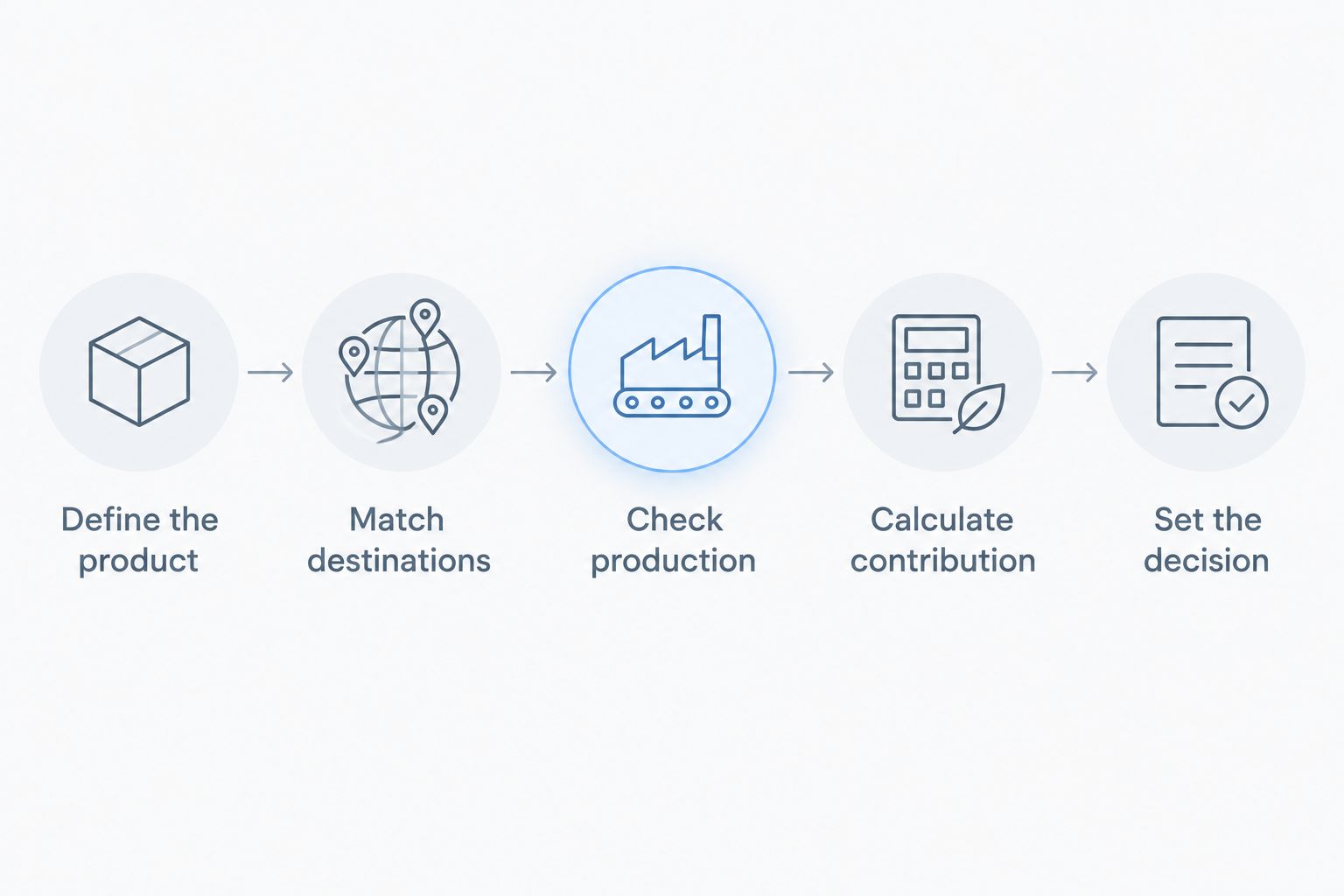
Match the order specification before ranking the supplier.
How we ranked
This shortlist ranks distinct buying situations: supplier comparison first, a single-provider workflow second, and regional production evaluation third. It does not assign unverified margin percentages to Printify, Printful or Gelato.
The ranking criteria are delivered production cost, product comparability, handling, quality acceptance, destination fit and personalisation handoff. Your measured contribution determines the final order—not the shortlist position.
Which print-on-demand app should you choose?
Start with Printify if supplier comparison is your main task. Evaluate Printful if you want a single-provider workflow, and Gelato if production across customer markets is central to the decision.
For personalised merchandise, choose the customisation layer and production route as separate decisions. Validate how customer choices reach fulfilment before treating the workflow as ready to sell.
Keep the 2026 launch narrow. Publish the products that pass both the quality check and your contribution target. Leave the rest out until their economics justify the work.
FAQ
What's the best print-on-demand app for Shopify profit margin?
The best app is the one that produces the highest measured contribution for your matched product and destination while meeting your quality requirements. Start with Printify for supplier comparison, Printful for a single-provider workflow, or Gelato for regional production evaluation.
Does Printify always give better margins than Printful?
No universal margin ranking applies to every product and store. Compare the same specification, destination and order-handling requirements before choosing between Printify and Printful.
Is Gelato better for international Shopify stores?
Gelato belongs on the shortlist for merchants evaluating regional production across customer markets. Assess the specific product and destination rather than treating network reach as proof of better profitability.
Is Bespo a print-on-demand fulfilment supplier?
Bespo is a Shopify product personalisation app, not a substitute for your production supplier. It provides live-preview customisation and production-ready file outputs for fulfilment.
How do I calculate print-on-demand contribution margin?
Divide order contribution by net sales revenue and multiply by 100%. Calculate contribution after production, delivery, payment fees, attributable app charges, acquisition, variable handling, refunds and replacements.
Should I choose the lowest production charge?
Choose the strongest complete order economics, not the lowest production charge alone. Include delivery, quality acceptance and the manual work required to fulfil the order correctly.
Does personalisation guarantee higher profit?
Personalisation does not guarantee higher profit. Evaluate the revenue retained after the additional software, production, handling and correction costs attributable to personalised orders.
One last thing
A contribution-margin percentage is not the same as contribution per order. Track both. A higher percentage on a small order does not automatically leave more money to fund your business.
Before expanding your catalogue, identify the product-and-destination combinations that meet your contribution target with acceptable production quality. Expand from those results, not from the number of products an app lets you list.