
The blog
Is print on demand suitable for a luxury brand? 2026: Yes


Yes, print on demand can suit a luxury product brand in 2026, but only when the finished product, personalisation and fulfilment meet the brand’s standards. It is a production model, not a shortcut to a premium result. If a supplier cannot reproduce an approved sample consistently or support the presentation you promise, use a more controlled production route.
TL;DR
- Is print on demand suitable for a luxury brand? Yes, when approved samples and repeatable quality support the brand promise.
- Print on demand reduces the need to hold finished personalised stock, but gives the brand less direct production control.
- Bespo is best for Shopify merchants who need live product personalisation, not a print-on-demand fulfilment supplier.
- Approve the finished item, packaging and production handoff before offering a personalised product at scale.
Why this matters
A luxury customer judges the item they receive, not the production model behind it. A product page can show a considered design, but the material, placement of a monogram and condition on arrival determine whether the purchase feels consistent with that promise. The decision is not whether print on demand sounds premium. It is whether your production route can deliver the result your brand shows.
Print on demand and personalisation are separate choices. Print on demand describes when and how an item is produced after an order. Personalisation describes what the customer can change. A brand can use both, use either, or produce personalised items through its own workshop. If you sell Shopify products such as engraved accessories, the luxury pen and stationery customiser guide offers a relevant category example; this page focuses on the production decision.
Is print on demand suitable for a luxury product brand?
Yes, if you can approve the exact finished configuration and keep the customer experience consistent across orders. In 2026, assess print on demand against the product you intend to sell, rather than against a generic supplier catalogue. Ask for a sample with the same material, decoration method, artwork placement and packaging specified for customer orders.
Print on demand
- Best for: Testing a product that passes a finished-sample review
- Advantage: You do not need to hold finished personalised units before orders arrive
- Trade-off to check: A third party controls production and dispatch; confirm what you can inspect and change
In-house or directly managed production
- Best for: Products with strict material, finish or presentation requirements
- Advantage: Your team has direct oversight of the production process
- Trade-off to check: You must organise equipment, capacity and order handling
Split production
- Best for: A brand with some products that pass supplier review and others that need direct oversight
- Advantage: You can choose the production route by product
- Trade-off to check: Each route needs its own quality checks and customer-facing expectations
None of these routes earns a luxury position on its own. A passing sample is a starting point; a reliable handoff from customer choice to finished item is the harder test. If you cannot define what the supplier must make, inspect and pack, do not put that configuration on sale yet.
The table also exposes a useful distinction. Production control is not the same as storefront control. You can give shoppers clear personalisation choices while a supplier fulfils the order, or produce in-house while presenting a confusing product page. Review both halves separately.
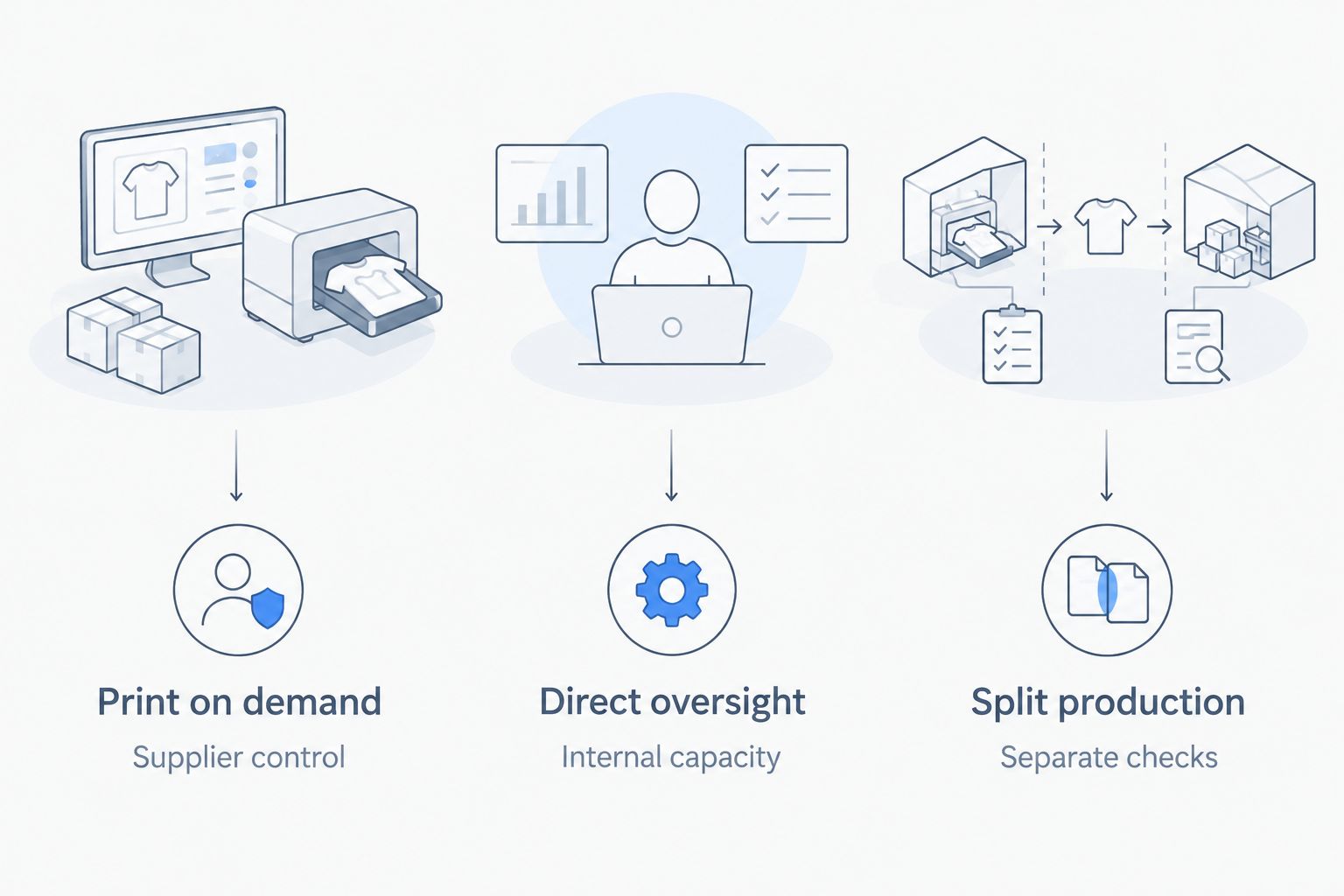
Choose the production route by product, then check the trade-off that comes with it.
What should you verify before saying yes?
Use an approval sequence that matches the promise on your product page:
- Approve the base item. Handle the material and examine the finish before judging the added print, embroidery or engraving. A strong design does not compensate for an item that falls short of your standard.
- Approve the personalisation. Order the configuration a shopper will receive. Check its position, legibility and how it sits on the material, not just the artwork file.
- Approve the presentation. Inspect the delivered package and the item inside it. Make your product photography and description reflect what actually arrives.
- Approve the handoff. Confirm how customer choices reach production and who checks the order against them. A correct preview cannot fix a wrong production instruction.
- Approve the exception process. Decide who handles an unclear design, a failed quality check or a damaged item before taking customer orders.
This is a go/no-go test, not a promise that every later order will match the sample. Record the approved configuration so the supplier and your team are checking against the same specification. Repeat the review when you change the base item, decoration method or production route.
Print on demand: best for approved, repeatable products
Print on demand fits a luxury range when a supplier can reproduce the approved item and your brand can set clear expectations for the order. It is particularly useful when you do not want to commit to finished personalised inventory before seeing demand. Verdict: use it for products that pass a physical sample review; hold products that have not.
The benefit is operational flexibility. The drawback is distance from the workbench: you depend on another business to follow the production instructions and deliver the item as specified. That trade-off matters most when a small change in placement, finish or presentation changes how the product feels to the buyer.
Do not approve print on demand by looking at a digital mock-up alone. Review a delivered sample of the actual configuration. Then establish how you will spot and resolve deviations. If the supplier cannot show how customer choices become production instructions, the storefront experience is not ready to sell.
Directly managed production: best for exacting finishes
In-house or directly managed production makes sense when the finish, material or final inspection requires close oversight. You can define the standard at the point of production and decide whether an item passes before it leaves. Verdict: use direct oversight when an external supplier cannot reproduce your approved result.
The cost is operational responsibility rather than a quoted figure. Your team must organise the work, handle changes to customer instructions and keep production aligned with the product page. Direct control does not remove errors by itself; it gives you a clearer place to catch them.
For a luxury range, put the acceptance criteria in writing. Specify the approved base item, decoration position, finish and presentation. If a team member cannot determine whether a finished item passes without asking the person who designed it, the criteria need more detail.
Split production: best for mixed product ranges
A split approach keeps suitable products with a print-on-demand supplier and routes more demanding work through direct oversight. Verdict: split the range by what each product needs, not by a blanket rule about luxury.
This approach protects a brand from forcing every item through one workflow. Its drawback is complexity: customers should not have to work out which production route applies to their purchase, while your team must keep each route’s instructions and checks distinct. Write the customer-facing description around the delivered product, then make sure each route can fulfil it.
Do not assume a technique determines the route. Embroidery, engraving and print can each produce different outcomes on different base items. Review the completed product and its presentation; the technique name alone cannot tell you whether the result fits your range.
Why suitability varies
- Base item: Start with the material and construction. Personalisation adds to an item; it does not change the quality of the item underneath.
- Decoration method: Assess print, embroidery, engraving or another specified method on the material you intend to sell. A convincing artwork preview is not a physical proof.
- Placement and legibility: Check the approved design on the finished product. Give production instructions that identify where the personalisation belongs.
- Presentation: Compare the delivered item and packaging with the impression created by your product page. A mismatch is part of the customer experience.
- Order handoff: Confirm that the customer’s selected text or design reaches the producer accurately and can be checked against the order.
- Exception handling: Decide what happens when a file, instruction or completed item does not pass review. A process you cannot explain is not ready to scale.
For Shopify merchants, this last part connects the product page to fulfilment. Bespo is a Shopify product personalisation app with a live-preview customiser and production-ready files. It supports the customer-choice and production-file side of that handoff; it is not itself a print-on-demand fulfilment supplier. Bespo is best for Shopify merchants who need shoppers to preview personalisation and the production team to receive usable files, provided the merchant separately approves the physical result.
A live preview helps a shopper check their choices before ordering. It does not verify the base item, the finished decoration or the package that arrives. Keep the digital approval and physical approval as separate steps in your 2026 launch checklist.
Can a luxury brand use print on demand for personalised goods?
Yes, a luxury brand can use print on demand for personalised goods in 2026 when the delivered sample matches the item it advertises and the supplier can follow the approved instructions. Check the finished personalisation and the order handoff, not just the uncustomised base item.
If the buyer can change text or design, show what they are choosing and set clear limits on those choices. Then verify that production receives the choice in a usable form. A beautiful storefront preview has little value when the final file or instruction does not match the customer’s order.
Is print on demand better than producing luxury items in-house?
No production route is automatically better for a luxury brand in 2026. Print on demand is a fit when an approved supplier can deliver your specified result; in-house work is a fit when the result needs direct production oversight. Judge both against the same finished-item criteria.
Make the comparison with actual samples rather than a general claim about either route. If both pass, choose based on which workflow your team can manage and verify. If neither passes, revise the product or the specification before offering it for sale.
Does a live preview make a print-on-demand product premium?
No. A live preview clarifies the customer’s choice; it does not determine physical quality. In 2026, treat the preview as part of the buying experience and the delivered sample as evidence of the finished product.
Bespo can help a Shopify merchant show personalisation choices and output production-ready files. The merchant still needs to approve materials, production and presentation. That division of responsibility keeps a digital tool from being mistaken for a quality guarantee.
FAQ
Is print on demand suitable for a luxury brand?
Yes, when a delivered sample meets the brand’s product and presentation standards and the supplier can follow the approved specification. Reject configurations that pass only as digital mock-ups.
What should a luxury brand check before using print on demand?
Check the base item, finished personalisation, packaging and transfer of customer choices to production. Approve a delivered sample that matches the configuration you plan to sell.
Is print on demand the same as product personalisation?
No. Print on demand describes a production model, while personalisation describes the choices offered to a customer. A brand can combine them or use either one separately.
Can I sell personalised luxury products on Shopify?
Yes, Shopify merchants can present personalisation choices and arrange production for the resulting orders. Bespo provides a live-preview customiser and production-ready files, but the merchant must approve the physical product and fulfilment route.
Should a luxury brand use print on demand or in-house production?
Choose the route that reproduces the approved finished product and lets your team verify it. Use direct oversight when a print-on-demand supplier cannot meet the specified result.
Does a live product preview replace a physical sample?
No. A preview shows a shopper’s selected design, while a physical sample reveals the material, applied decoration and presentation. Review both before offering the configuration.
What is the biggest risk with print on demand for a luxury brand?
The risk is a gap between the product shown online and the item delivered. Define an approved specification and a process for checking exceptions before accepting orders.
One last thing
The decisive sample is not the plain product. It is the delivered, personalised item in the configuration a customer can actually order. Before adding it to a luxury range in 2026, inspect that complete experience and write down what passes.