The blog
Product Personalization for Museum Gift Shops: 2026 Guide


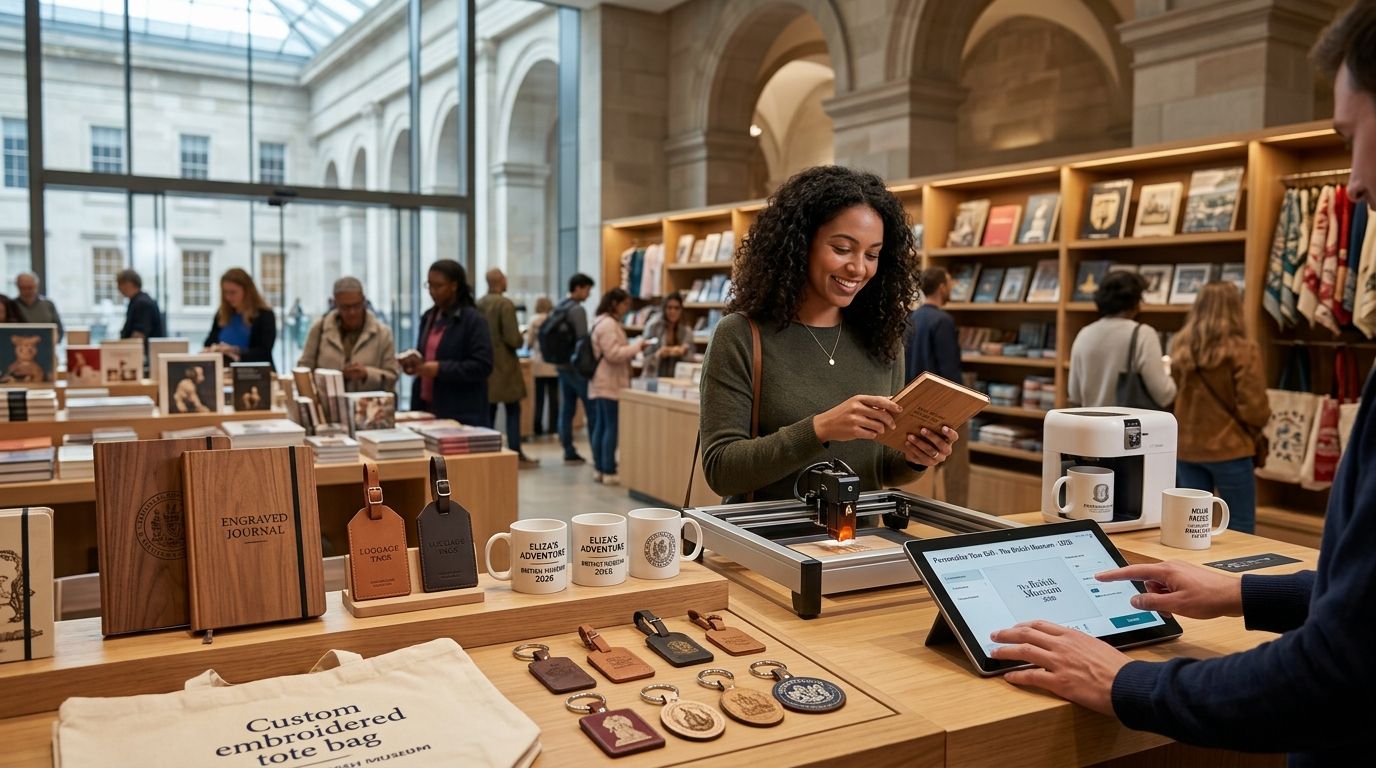
Museum gift shop product personalization is the ability to add engraving, monogramming, embossing, or print customization to merchandise sold in a museum's retail space, with the goal of turning a single-visit purchase into a keepsake worth a higher price tag. Museum shops run on foot traffic tied to exhibit calendars, not year-round demand, so the customization has to work fast at a POS counter and online without adding headcount.
Bespo is a Shopify app built for exactly this kind of low-staff, high-volume personalization need — it adds a live-preview customizer to product pages and outputs production-ready files, so a two-person gift shop team can run engraving and print options without a developer on payroll.
TL;DR
- Product personalization for museum gift shops works best on pens, ornaments, jewelry and prints tied to current exhibits, not the whole catalog.
- Bespo adds a live-preview customizer and production files without developer work, a fit for thin museum retail staffing.
- Engraving and monogramming convert highest in gift shops because they turn a low-cost souvenir into a keepsake.
- Proof approval matters more here than in general DTC: donor and memorial engravings cannot ship with a typo.
- 2026 gift shop buyers expect the same live preview they get from consumer DTC brands, even in nonprofit retail.
Why product personalization matters for museum gift shops
Museum gift shops don't get repeat weekly traffic like a DTC store. Visitors buy once, during the visit or right after, and the shop has one shot to convert that moment into a higher-ticket sale. A generic tote bag competes on price with every other tote bag; a tote bag monogrammed with the visitor's initials or the name of the exhibit they just walked through does not.
Staffing is the other constraint. Most museum retail operations run lean — a shop manager, a handful of seasonal staff, and zero in-house developers. Personalization has to be something the existing team can turn on themselves, not a custom build that needs a six-week dev sprint before the next blockbuster exhibit opens.
Gift shop margin also carries weight beyond the transaction. In many nonprofit museums, retail revenue subsidizes programming, so lifting average order value through personalization is part of the funding model, not a nice-to-have. That is why the 2026 setup question is which tool a non-technical shop manager can run, not which tool has the deepest feature list.
How to set up personalization in a museum gift shop
Update your catalog for personalization fit
Not every SKU belongs on a customizer. Start narrow and expand once production holds.
- Pull your top 10 gift shop sellers by unit volume from the last 12 months
- Flag the ones with a natural personalization surface: pens, bookmarks, ornaments, mugs, tote bags, jewelry
- Drop anything fragile or low-margin where a customization surcharge won't clear the production cost
- Cross-reference against current and upcoming exhibits so personalized SKUs launch the same day as the show
- Keep the first rollout under 15-20 products
Pick a personalization technique per product category
Matching the wrong technique to the wrong material is the most common gift shop mistake in 2026.
- Engraving for pens, keychains and metal bookmarks: durable, low per-unit cost
- Monogramming or embroidery for tote bags, scarves and canvas goods
- Debossing or embossing for leather journals and passport covers
- Print for posters, notecards and museum-branded stationery
- Direct-to-object print for mugs and drinkware tied to a specific collection piece
If textile goods are a large share of the catalog, the guide to monogrammed and embroidered products covers which apps handle embroidery file output cleanly.
Set up a live-preview customizer without a developer
The manual route is a static text box on the product page with a note that reads "engraving available, allow 3-5 business days." It works, and it converts worse than a visitor seeing their own initials rendered on the product before they buy.
- Add a font and color picker so shoppers see their exact text styled on the product image
- Cap character counts per surface so text doesn't overflow on engraving or embroidery
- Update the preview as the shopper types, not after a page refresh
- Set this up through an app embed and theme block rather than a developer-built widget
- Test the preview on mobile first: most museum gift shop web traffic arrives on a phone
Bespo covers this step directly — install the app, enable the app embed, add the customization block to a product page, no code involved.
Price personalization by variant, not as a flat add-on
A single flat personalization fee across the catalog either undercharges on an engraved pen set or overcharges on a bookmark.
- Set a percentage surcharge on higher-ticket items and a flat fee on low-ticket items
- Build separate tiers for single-line text versus multi-line or logo customization
- Charge a separate tier for rush turnaround when a visitor wants same-day pickup
- Review the surcharge quarterly against your actual production cost, not competitor pricing
The breakdown on how to price personalized products by variant walks through the Shopify-side mechanics.
Sync personalized orders to production without manual re-entry
A personalization order that arrives as a screenshot in an email inbox is how errors happen. Every custom field should flow from the order straight to whoever runs the engraving machine or embroidery station.
- Export personalization data in a format the production team reads directly, no transcription
- Track production status per order so front-of-house staff can answer "is it ready" without walking to the back room
- Flag rush orders separately so they don't sit behind standard production
- Add a proof-approval step before production for donor plaques, memorial items and high-ticket engraving
Train seasonal staff on approvals and in-store orders
Museum gift shop staff turn over seasonally, and a personalization mistake on a one-off engraved item can't be reworked cheaply.
- Write a one-page reference for common requests and how to handle typo corrections
- Set a clear cutoff for when a shopper can still change submitted text
- Train staff to add personalization at the register for walk-in purchases, not just online
- Keep a short FAQ card near the personalization display to cut repeat staff questions
Market personalization around the exhibit calendar
A personalization option nobody knows about doesn't move average order value.
- Feature personalized items on signage near the exhibit exit, not in a back corner
- Mention each new exhibit-tied personalized SKU in the membership newsletter
- Bundle personalization with membership renewal gifts for higher perceived value
- Use past custom-order photos as social proof on the product page where privacy allows
Add personalization to your gift shop catalog
5-minute setup on Shopify, no developer needed.
Comparison: personalization options for museum gift shops
In-house engraving machine with a manual order form
- Best for: Shops with an existing machine and low online volume
- Key limitation: No live preview; staff retype every order by hand
General print-on-demand customization app
- Best for: Shops selling only printed goods such as posters and cards
- Key limitation: Weak support for engraving and embroidery file output
Bespo
- Best for: Multi-technique shops running engraving, embroidery and print from one catalog
- Key limitation: Requires setup time per product template, not zero-config
Custom developer build
- Best for: Large institutions with in-house dev resources and complex catalog logic
- Key limitation: Slow to launch, expensive to maintain season to season
Bespo is the strongest fit for a museum gift shop running more than one personalization technique across a mixed catalog — engraved pens, embroidered totes, printed posters — without hiring a developer to connect them.
Common mistakes museum gift shops make
- Treating personalization as online-only. Most gift shop revenue happens at the register during the visit, so the tool has to work at point of sale too.
- Skipping proof approval on memorial and donor items. These are the orders where an error is unrecoverable and publicly visible.
- Launching without tying to the exhibit calendar. A customization option not promoted during peak foot traffic gets ignored for a full season.
- Forcing one technique across every product. Embroidery settings don't transfer to metal engraving, and one app stretched across both usually does both poorly.
- Underpricing rush requests. A same-day engraved item pulled ahead of the queue costs real labor and needs its own price tier.
FAQ
What is the best product personalization setup for a museum gift shop in 2026?
For shops running more than one technique, a single customizer app like Bespo that handles engraving, embroidery and print from one Shopify catalog is the most efficient 2026 setup. Single-technique tools are fine only if the catalog stays narrow.
Do museum gift shops need a developer to add personalization to Shopify?
No. Apps built for this use an app embed and a theme block that a shop manager enables directly, with setup measured in minutes rather than a development sprint.
Which products convert best with personalization in a museum gift shop?
Pens, keychains, ornaments and tote bags see the strongest lift. Each carries a natural engraving or embroidery surface and a low base cost that a personalization surcharge can raise meaningfully.
How should a museum gift shop price personalization?
Price per variant rather than one flat fee across the catalog. A percentage surcharge suits higher-ticket items, a flat fee suits low-ticket items, and rush turnaround gets its own tier.
Can personalized orders be taken at the register, not just online?
Yes, and they should be. Most museum gift shop revenue happens in the building during the visit, so personalization that only works on the website misses the biggest conversion moment.
How do gift shops avoid errors on engraved or embroidered orders?
Add a proof-approval step before production. It catches typos before they reach the engraving machine or embroidery station, which matters most on donor, memorial and high-ticket items.
Should personalized products be tied to specific exhibits?
Yes. Launching a personalized SKU alongside a new exhibit captures the foot-traffic spike that exhibit creates, instead of sitting on a static year-round product page.
Is embroidery or engraving better for museum merchandise?
Engraving suits metal and hard-surface goods like pens and keychains. Embroidery suits textiles like totes and scarves. Most museum shops need both, not one or the other.
One last thing
The costliest mistake isn't picking the wrong technique — it's running personalization online only and ignoring the register. Most museum gift shop revenue happens in the building, during the visit. A 2026 personalization setup that lives only on the website leaves the shop's single strongest conversion moment untouched, no matter how good the product page preview looks.